A useful humanoid robot parts list is not a shopping list copied from one finished platform. It is a bill of materials organized around functions, interfaces, and delivery boundaries. Start with the motion path, add sensing and control, then account for every support item that lets those systems work together. This approach exposes missing bearings, cables, fasteners, thermal paths, and documentation before they delay a prototype.
One real platform illustrates why the list must be system-specific. The official ROBOTIS OP3 documentation identifies actuators, a main computer, a sub-controller, camera, IMU, battery, networking, and I/O. Its separate hardware page adds frames, covers, boards, speaker, and mechanical design files. That is evidence of one architecture, not a universal quantity or brand prescription.
Build the Humanoid Robot Parts List by Subsystem

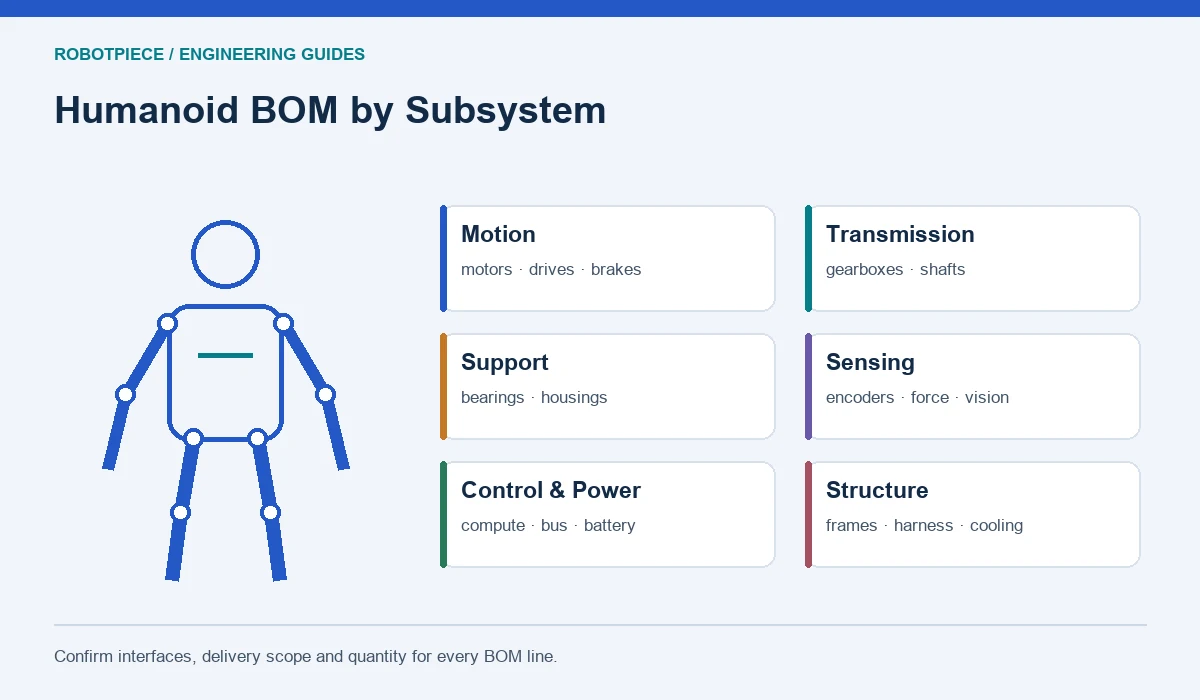
Break the parts of a humanoid robot into six connected groups. The boundaries matter because one supplier may quote a complete module while another quotes only a component inside it.
| Subsystem | Typical BOM lines | Critical interfaces |
|---|---|---|
| Motion | Motors, drives, encoders, brakes, joint modules, grippers | Voltage, current, feedback protocol, torque-speed duty |
| Transmission | Precision gearboxes, couplings, shafts | Ratio, backlash or lost motion, mounting datum, lubrication |
| Support | Cross-roller, angular-contact, thin-section, and other bearings | Load direction, moment load, fits, preload, stiffness |
| Sensing | Joint encoders, force/torque sensors, IMU, vision | Range, resolution, accuracy, bandwidth, mechanical frame |
| Control and power | Main computer, real-time controller, communication, battery, protection | Bus topology, update rate, power budget, connectors, safety state |
| Structure and integration | Frames, covers, robot integration hardware, harnesses, thermal interfaces | Mass, envelope, routing, grounding, cooling, service access |
This functional view is more dependable than a list of humanoid robot body parts such as “arm,” “leg,” and “torso.” A leg BOM, for example, usually repeats joints but still needs different load cases, cable lengths, housings, and end interfaces at the hip, knee, and ankle.
Choose Complete Joint Modules or Component-Level Integration
A complete joint actuator may combine a motor, reducer, feedback device, bearings, housing, and sometimes a drive or brake. A component-level design may source each item separately. Neither route is automatically better. The first can reduce integration work; the second can give more control over envelope, thermal design, stiffness, and serviceability.
For every joint, add a delivery-scope column to the BOM. Mark each function as included, optional, or customer-supplied. Do not assume that a “motor” includes an encoder, that a “gearbox” includes an output bearing, or that a “joint module” includes a drive. Compare the scope using the joint actuator module category and the broader RobotPiece component categories.
Humanoid Robot Body Parts: Interface Specifications
Specify the parts of humanoid robot assemblies by the interfaces that must connect. For motion parts, record continuous and peak torque, input and output speed, duty cycle, bus voltage, allowable temperature, and control mode. For mechanical items, record the drawing revision, datum scheme, shaft and housing fits, permissible runout, fastener pattern, and allowable mass. For sensing, record measurement range, accuracy definition, sample rate, interface, connector, and calibration deliverables.
Separate requirements from candidate values. “24-bit encoder” is a candidate feature; “output position uncertainty under the stated load and temperature” is a requirement. Likewise, a catalog torque is not enough unless its operating conditions match the robot’s duty. This distinction makes substitutions reviewable rather than speculative across the parts of humanoid robot assemblies.
Plan Prototypes, Alternatives, and Production Quantities
A practical humanoid robot parts list should carry three quantity columns: engineering samples, prototype build, and expected production lot. Add spare quantities where failures or destructive assembly trials are plausible. Keep alternates on separate lines with their own drawings and approval status; similar dimensions do not prove interchangeability.
- Samples: enough units for fit, wiring, thermal, and control integration.
- Prototype build: complete robot quantity plus documented spares.
- Production: lot size, forecast, delivery cadence, and traceability needs.
- Quality records: inspection report, calibration file, certificate, serial tracking, or material record only where the project requires them.
Turn the BOM into an Effective RFQ
Use the humanoid robot BOM checklist below to freeze the BOM revision and identify open technical questions before requesting quotes. Attach the humanoid robot parts list to the RFQ so suppliers can mark included parts, alternatives, and exclusions against the same revision. Attach interface drawings for custom-fit components. For each line, provide quantity, target schedule, acceptable brands or source restrictions, and required documents. If the form does not accept files, mention the drawing package in your message and send it through the listed email channel after contact is established.
Humanoid Robot BOM Checklist
- Every joint and repeated assembly has a unique item or controlled quantity.
- Included, optional, and customer-supplied parts are separated.
- Mechanical, electrical, control, thermal, and documentation interfaces have owners.
- Prototype, spare, and production quantities use the same BOM revision.
- Each proposed alternative has its own drawing, evidence, and approval status.
RobotPiece is an independent sourcing contact in Shenzhen. It can help review component-level requirements and supplier delivery scope; final engineering approval remains with the robot developer. Add catalog components to the quote list, or submit the BOM, operating conditions and quantities through the RobotPiece inquiry form.
References
- ROBOTIS OP3 Introduction — example platform specification and package scope.
- ROBOTIS OP3 Hardware — example mechanical, electronics, and cover data.