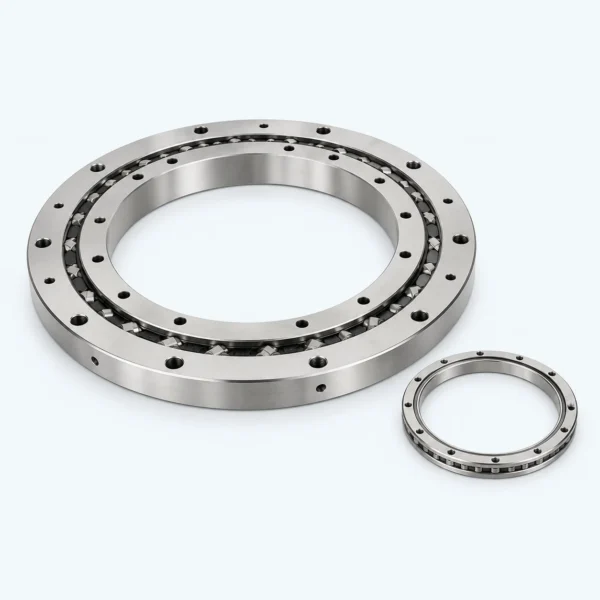
Cross Roller Bearing for Robot Joints
A robot joint bearing supports the combined radial, axial, and moment loads acting through a rotary joint. This RFQ page focuses on cross-roller configurations for robot joints, reducers, rotary tables, and compact precision mechanisms. It is not a fixed bearing model, a dimensional interchange promise, or a stocked-item listing. RobotPiece reviews the real load case, geometry, fits, preload, accuracy, lubrication, life target, and assembly method before proposing a bearing configuration.
A cross roller bearing arranges rolling elements so the bearing can react to loads in multiple directions within a compact section. The term crossed roller bearing is also widely used for this family, but neither phrase defines a universal ring structure, preload, accuracy class, seal arrangement, or mounting method. A precision robot bearing needs to be considered with its housing and shaft because fits and clamping can change internal clearance, running torque, stiffness, and accuracy. For a robot joint support bearing, the adjacent reducer and output flange may also determine moment loading and permissible deformation.
Selection and Engineering Requirements

A cross roller bearing and crossed roller bearing are common names for this bearing family, but ring structure, holes, preload, seals, and accuracy still vary. A precision robot bearing must be reviewed with its housing and clamping conditions. A robot joint support bearing also needs the real radial, axial, and moment load spectrum rather than a selection based only on bore and outside diameter.
When a drawing calls for a cross roller bearing or crossed roller bearing, include its ring and mounting arrangement. A precision robot bearing or robot joint support bearing cannot be confirmed from a generic family description.
Provide the required bore, outside diameter, width, available shoulder geometry, fillets, bolt pattern if applicable, and the shaft and housing materials. Include the interface drawing and tolerances rather than only nominal dimensions. State whether the rings are split or need special handling, how the bearing is retained and clamped, and whether the design requires an integrated mounting style or a separable bearing arrangement.
The load case should distinguish radial force, axial force, overturning moment, direction, speed, acceleration, oscillation angle, duty cycle, shock events, and any external process load. State the desired life or operating cycles and the acceptable deflection, runout, starting torque, and running torque. If preload, internal clearance, or accuracy class is specified, include the relevant definition and assembly condition. Describe temperature, cleanliness, contamination, vacuum, corrosion, lubrication, seals, and maintenance expectations.
Engineering Reference
This cross-roller technical resource provides background on selection, preload, rotation accuracy, mounting, and maintenance. It does not define the capacity, accuracy, or fit of a bearing proposed through this RFQ. Review the technical background.
Scope and Configuration to Confirm
The quotation should identify the bearing arrangement, nominal interfaces, accuracy and preload or clearance condition, seals where applicable, lubrication state, and packaging. Housing, shaft, spacers, retaining rings, fasteners, grease, installation tools, inspection reports, and matched components are separate unless listed. If a current bearing is being replaced, provide the full designation and drawing, but do not assume interchangeability until dimensions, tolerances, load ratings, preload, and mounting details have been checked.
Current specifications are confirmed per requirement. RobotPiece does not estimate carrying capacity or life from outside diameter alone. A product-type illustration indicates the category, not the final ring design or delivered item. Final dimensions, holes, seals, finish, and packaging depend on the approved bearing configuration.
Inquiry Checklist
- Bore, outside diameter, width, shoulder geometry, bolt pattern, and interface drawing
- Radial, axial, and moment loads plus speed, oscillation, duty, shock, and life target
- Preload or clearance, stiffness, deflection, runout, and torque expectations
- Shaft and housing fits, clamping method, ring structure, assembly, and retention
- Temperature, cleanliness, lubrication, sealing, corrosion, and maintenance conditions
- Quantity, destination, prototype schedule, inspection records, and packaging needs
Send the load case and mechanical drawing through the RobotPiece contact page. Explore related support components in the Bearings category.
Frequently Asked Questions
Can I select a robot joint bearing from bore and outside diameter?
No. Width, ring arrangement, holes, accuracy, preload, fits, lubrication, speed, combined loads, life, and assembly method can differ even when two bearings share nominal diameters.
Does the bearing carry the gearbox output load without other support?
That depends on the selected bearing and the complete joint structure. Provide radial, axial, and moment loads plus housing and shaft geometry so the support arrangement can be reviewed as a system.
Image note: the cover is a conceptual product-type illustration, not a photograph of a confirmed model. Actual appearance, dimensions, connectors and supplied items must be confirmed in the quotation.
