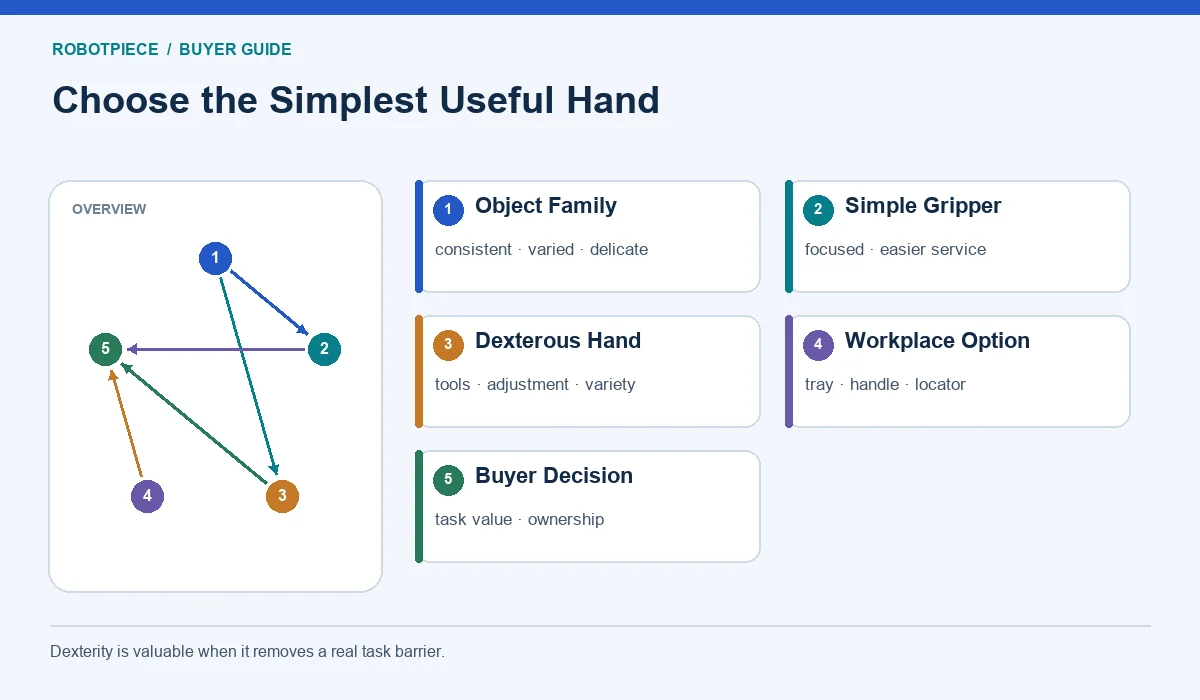
Humanoid gripper vs dexterous hand selection should follow the object and the work step. A simple gripper is often the better purchase for repeated handling of consistent items. A dexterous hand becomes worth considering when the task needs several contact points, in-hand adjustment, human tools, or object shapes that cannot be reduced to one stable grip.
The comparison in humanoid gripper vs dexterous hand selection must account for the fact that more fingers create more possible actions, but they also create more setup, wear points, replacement parts, and failure modes. Buyers should pay for dexterity only where it changes the task outcome.
Simple Gripper for Humanoid Tasks
A simple gripper for humanoid tasks works well when objects have a known pickup area and can be held with a simple opening-and-closing motion. Boxes, trays, machined parts, and standard containers are common examples when presentation is controlled.
That simpler mechanism also has fewer moving parts, which can make operation and maintenance easier to understand. Operators can often see whether the object sits correctly. Spare fingers or pads may be easier to stock. A focused electric parallel gripper may therefore create more value than a complex hand in a stable process.
If object variation is moderate, an adaptive robot gripper may cover a broader family without moving to a human-like hand. The real item range still needs to be confirmed.
Dexterous Hand Tool Use
Dexterous hand tool use may justify more capability when the robot must use tools, reposition an object without putting it down, handle shapes with no single obvious grasp, or interact with controls designed around fingers. It can also support tasks where a humanoid is expected to move among different human workstations.
The purchase boundary changes with dexterous hand tool use. A dexterous robot hand may include many separate items. Buyers should ask what fingers, pads, actuators, sensing, cables, controller, software, and replacement items are included. A demonstration with one object does not establish suitability for a full product mix.
| Work requirement | Simple gripper | Dexterous hand |
|---|---|---|
| Consistent carton or tray | Often sufficient | May add unused complexity |
| Many human tools or controls | May require tool-specific fingers | May offer broader interaction |
| In-hand repositioning | Usually limited | Potential reason for multiple fingers |
| Maintenance simplicity | Fewer wear items to manage | More joints, pads, and service questions |
| Object family growth | May need finger changes | May cover more objects if proven |

Humanoid End Effector Tradeoffs
Humanoid end effector tradeoffs begin with object presentation. Before buying more dexterity, examine presentation. A tray, locating feature, handle, fixture, or standard container can turn a difficult free-form pickup into a dependable grasp. If a small workplace change reduces uncertainty, it may be easier to operate than a hand expected to adapt to every incoming item.
At some sites, humanoid end effector tradeoffs favor versatility. A business with many existing tools and low-volume tasks may not want a custom fixture for each operation. In that setting, a versatile hand may reduce repeated tooling projects. The value depends on how many real tasks share the capability.
Include Touch Only Where It Helps the Decision
Force or tactile feedback can help a hand notice contact and handle delicate or uncertain objects. It does not automatically make the task safe or reliable. The supplier should explain which decisions use the feedback and what the robot does when the reading is uncertain.
For replaceable contact surfaces, robot gripper fingers and pads can affect grip, wear, cleaning, and service. Buyers should include these consumable or replaceable items in the maintenance discussion rather than treating the hand as one permanent unit.
Robot Hand Maintenance Requirements
Robot hand maintenance requirements include who creates new grasps, who approves a new object, how long a change takes, and which staff can perform it. Review cleaning, pad replacement, damaged-finger recovery, spare availability, and the method for returning to work after a failed pickup.
The design changes robot hand maintenance requirements: a dexterous hand may reduce tool changes but increase task setup. A simple gripper may be easier to support but require several finger sets. Compare the recurring work, not only the initial hardware price.
Use Real Objects in the Decision
Bring representative items, including normal variation and difficult examples. Ask the supplier to show pickup, movement, placement, and recovery using the quoted end effector. Include items with packaging wear or orientation changes if they occur in normal operations.
A hypothetical electronics operation handling standard trays may choose a simple gripper with custom pads. A service robot expected to operate several existing hand tools may justify a dexterous hand. These examples illustrate different task needs; they do not promise performance.
Favor the simplest end effector that completes the valuable task range with an acceptable operating and maintenance burden. Dexterity matters when it removes a real task barrier, not when it merely makes the robot appear more human.
References
- Alishba Imran and Keerthana Gopalakrishnan, AI for Robotics, humanoid end-effectors and tactile feedback, PDF pp. 424–425 (printed pp. 411–412), Apress, 2025.
- Wei Zhang, Guoyu Zuo, and Xingxing Wang, Humanoid Robots: Fundamentals and Applications, force and tactile sensing and dexterous-hand outlook, PDF pp. 242–246 and 43 (printed pp. 234–238 and 32), Springer Singapore / China Machine Press, 2026.