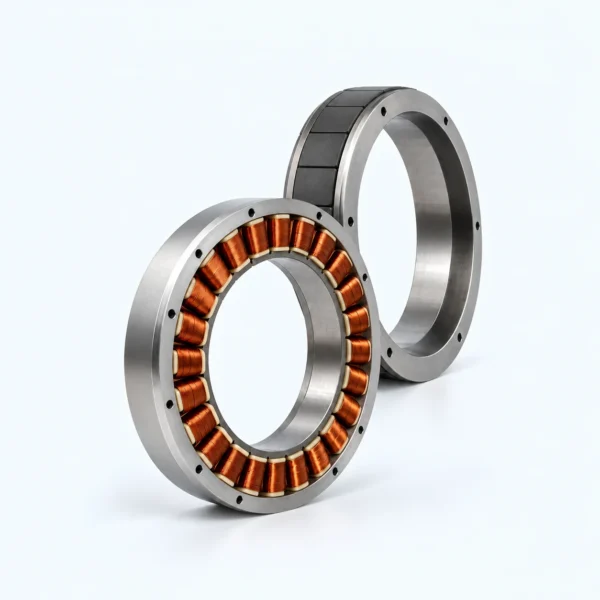
Frameless Torque Motor Kit for Robot Joint Integration
A frameless motor supplies a stator and rotor that are integrated directly into the customer’s mechanical assembly. This product-type RFQ is intended for robot joints, gimbals, actuators, medical mechanisms, and compact rotary systems where the housing, bearings, shaft, feedback, and thermal path are part of the customer design. It is not a fixed catalog model, complete servo axis, or stocked kit. RobotPiece evaluates the electromagnetic, mechanical, thermal, and drive requirements before proposing a configuration.
A frameless torque motor can reduce packaging duplication and support a large through-bore, but integration responsibility is greater than with a housed motor. The term frameless BLDC motor describes brushless commutation without defining winding, voltage, feedback, or torque performance. Likewise, a frameless servo motor becomes a servo system only after suitable feedback, drive electronics, control tuning, and mechanics are added. When requesting a frameless brushless DC motor, treat the rotor, stator, air gap, adhesive or retention method, bearings, encoder, cooling path, and drive as one design problem.
Selection and Engineering Requirements

A frameless torque motor is compared at the stated winding, speed, current, and thermal condition. The term frameless BLDC motor identifies an electronic commutation family, while frameless servo motor describes its use in a closed-loop axis. A frameless brushless DC motor still requires a controlled air gap, rotor support, heat path, feedback choice, and compatible drive before system performance can be assessed.
Whether the request says frameless torque motor, frameless BLDC motor, frameless servo motor, or frameless brushless DC motor, include the same mechanical and thermal integration inputs instead of relying on the label alone.
Provide the available stator outside diameter, stator inside diameter, active or total axial length, rotor geometry, required through-bore, and the preferred mounting and retention concept. If a mechanical drawing or section view exists, include it. The air-gap control, concentricity, runout, rotor support, assembly method, material near the magnetic circuit, and operating speed all affect integration and must be reviewed.
For electromagnetic selection, describe the required continuous torque, peak torque and duration, normal and maximum speed, duty cycle, supply or DC bus, continuous and peak current limits, and preferred winding or back-EMF behavior if already defined. Thermal information is essential: identify the mounting material, expected housing temperature, ambient conditions, cooling method, permissible winding temperature, and whether the application is enclosed. State the intended feedback device, servo drive, commutation method, switching frequency constraints, and control objective.
Engineering Reference
These electric-machines course notes provide background on electromagnetic torque and machine modeling. Use them to prepare engineering questions; the quotation and approved drawing determine the actual motor specification. Review the technical background.
Scope and Configuration to Confirm
A typical quotation may cover a matched rotor and stator, but it does not automatically include bearings, shaft, housing, encoder, Hall sensors, temperature sensors, brake, drive, cable, connectors, adhesive, retention hardware, assembly tooling, or balancing work. The exact rotor and stator supply condition, lead termination, sensor provision, insulation expectations, acceptance tests, drawings, and packaging need to be listed.
Current specifications are confirmed per requirement. Torque values are evaluated against speed, duty, winding, current, temperature, and cooling conditions; a peak value is not treated as a continuous rating. Product-type illustrations show the component concept only. The final construction, dimensions, lead arrangement, surface appearance, and included items depend on the approved motor design and supply scope.
Inquiry Checklist
- Application, axis function, target envelope, through-bore, and section drawing
- Continuous and peak torque, peak duration, speed range, and duty cycle
- DC bus or supply, current limits, winding preference, and intended servo drive
- Housing material, thermal path, cooling, ambient conditions, and temperature limits
- Air gap, rotor retention, bearings, encoder, sensors, leads, and connector concept
- Prototype and production quantities, destination, schedule, and required documents
Submit the motor envelope and operating profile through the RobotPiece contact page. You can browse the related Motors category for this product family.
Frequently Asked Questions
Is a frameless motor kit a complete motor?
No. The supply normally centers on a rotor and stator, while the customer assembly provides key mechanical and thermal functions. The quotation must explicitly identify every included sensor, lead, connector, assembly aid, and test deliverable.
Can a motor be selected from torque and diameter alone?
Not responsibly. Speed, duration, winding, voltage, current, cooling, allowable temperature, air gap, and integration geometry materially affect performance. Share the full duty profile and packaging constraints for a useful comparison.
Image note: the cover is a conceptual product-type illustration, not a photograph of a confirmed model. Actual appearance, dimensions, connectors and supplied items must be confirmed in the quotation.
