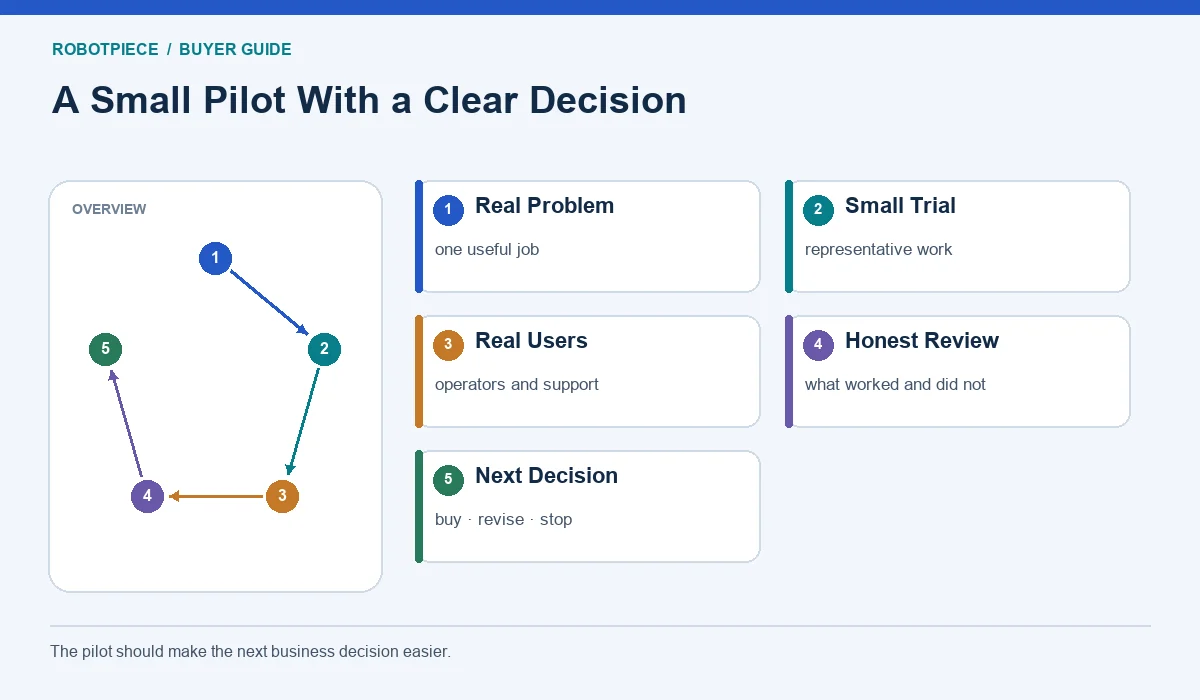
A robot automation pilot planning guide should help a buyer make a decision. It should not end with a polished video, a crowded visitor day, and no clear answer about what to do next. The best small pilot focuses on one useful job, involves the people who will live with the result, and finishes with an honest choice: move forward, change the plan, or stop.
This robot automation pilot planning guide does not require a large technical program. It requires a few practical questions before the robot arrives. What problem are we trying to solve? Who will use the system? What would make the trial worthwhile? What support will be needed? What decision will follow?
Robot Pilot Success Criteria
Robot pilot success criteria start with a job that customers and operators already understand. It might be moving a repetitive load, tending a machine, placing parts, inspecting a known feature, or handling an uncomfortable task. Avoid beginning with “We want to try a robot.” A robot is a possible answer, not the problem statement.
A useful statement of these robot pilot success criteria is: “We want to learn whether a robot can perform this specific job in our normal workplace without creating more work for the team.” This keeps the pilot close to the real need. It also prevents interesting extra features from taking over the trial.
Oliver Mitchell’s account of Kiva Systems describes a similar customer-first progression. The founders began with a costly warehouse problem, showed a working idea, invited customers to see a small system, and used those conversations to shape later pilots. The lesson for buyers is simple: connect the trial to a problem people already want to solve.
Plan a Small-Scale Robotics Trial
A small-scale robotics trial should cover a narrow task, but it should not hide the normal difficulty of the job. Use representative parts, operators, work areas, and daily conditions. If the robot only sees the easiest item in a quiet demonstration area, the result says little about ordinary use.
Set clear boundaries for the small-scale robotics trial. For example:
- one part family rather than every product;
- one workstation rather than the whole line;
- one normal shift pattern rather than a special visitor schedule;
- named operators rather than only supplier engineers; and
- a short list of expected exceptions rather than every imaginable failure.
When a pilot involves a robot joint or a new module, an integrated robot joint actuator may simplify the quoted component boundary. An actuator commissioning kit may help with initial setup. In both cases, confirm what is actually included and who is responsible for getting the complete trial ready.

Collect Operator Feedback in Automation Pilots
Operator feedback in automation pilots complements management priorities. Management may care about capacity and future rollout. Operators may care about loading, interruptions, and whether the robot makes the shift easier. Maintenance staff may care about access to help, replacement parts, and who is allowed to change the system. Purchasing may care about quote scope, delivery, and future costs.
Include these people early and record operator feedback in automation pilots. Their questions often reveal whether the pilot is solving the right problem. They can also identify work that a demonstration leaves out, such as resetting the area, changing a part, cleaning the equipment, calling for help, or returning the station to normal production.
Use a Simple Success Picture
You do not need a complicated scorecard. Agree on a short set of questions that everyone can understand:
- Did the robot complete the agreed task with the expected result?
- Could normal staff use the process after reasonable instruction?
- How often did supplier staff need to step in?
- What work remained outside the robot’s scope?
- Did the trial reveal new space, safety, tooling, software, or support needs?
- Would the team choose to continue with the same use case?
The answers should be written down during the pilot, including inconvenient moments. A pretty demo can hide repeated supplier intervention. A useful pilot shows how the system behaves when an operator needs help, a part is presented incorrectly, or the workday does not follow the script.
Define the Pilot to Purchase Decision
The pilot to purchase decision should be defined before the trial begins. Automation pilot planning should also name what follows the trial. If the result is positive, will the buyer request a production quote, extend the trial to another shift, or test a second workstation? If the result is mixed, who decides whether a limited change is worth trying? If the use case is a poor fit, can both sides stop without turning the pilot into an endless project?
Reciprocal commitment also strengthens the pilot to purchase decision. Mitchell’s book recounts founders asking customers what they wanted to learn and what purchase decision could follow a successful pilot. Another case in the book argues that customer commitment matters and that open-ended free trials often fail to create a real buying process. That is experience from particular companies, not a universal rule. The broader lesson is to ask for reciprocal commitment: time from the buyer’s team, access to real work, a named decision owner, and an agreed review date.
An Illustrative Small Pilot
Imagine a customer considering a robot for repetitive parts handling. This is an illustrative example, not a real RobotPiece case. The buyer selects one stable part family and one workstation. Two regular operators join the trial. The supplier explains what the robot will and will not do, who will answer support questions, and what equipment is included.
During the trial, the team records whether the job was completed, when help was needed, and what additional items would be required for normal use. At the end, the buyer chooses among three options: request a quote for the same use case, make one clearly defined change and repeat, or stop because the job is not a good fit. That decision is more valuable than a longer demonstration with no owner.
Robot Pilot Questions to Ask Before You Start
- What exact job and workplace are included?
- What will remain manual?
- Who represents operations, maintenance, purchasing, and the supplier?
- What equipment, tooling, setup, training, and support are included?
- What ordinary variations must the robot see?
- How will the team record supplier intervention and operator feedback?
- What date will the group review the result?
- What is the pilot-to-purchase decision if the trial is useful?
A robot automation pilot planning guide succeeds when the pilot makes the next decision easier. Keep the use case narrow, let real users see the complete work, record what happens without staging the answer, and agree on the next step before enthusiasm fades.
Sources and Further Reading
- Oliver Mitchell, A Startup Field Guide in the Age of Robots and AI (Chapman & Hall/CRC Press, 2025), Chapter 1, PDF pp. 19–23, and Chapter 4, PDF pp. 45–49.