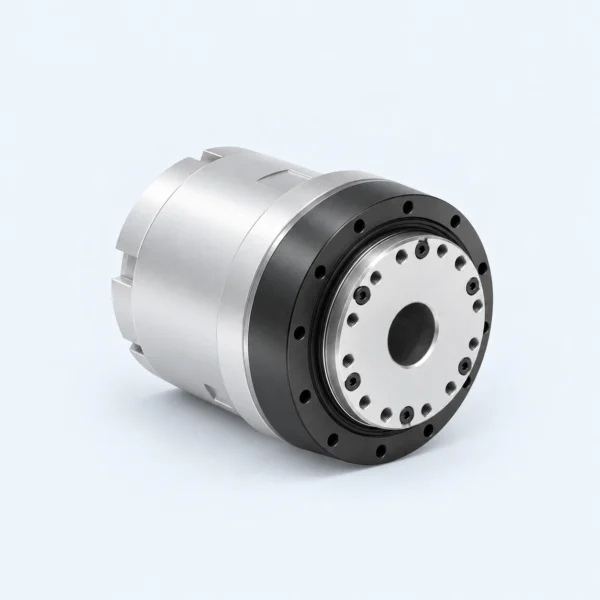
Integrated Robot Joint Actuator for Humanoid and Service Robots
A robot joint actuator combines the rotary drive functions required at a robot joint into a compact sourcing package. This page is an RFQ entry for engineers selecting an actuator for an arm, leg, waist, neck, or other rotary axis. It does not represent a fixed catalog model or a stocked configuration. RobotPiece reviews the application, mechanical envelope, motion duty, electrical architecture, and control requirements before proposing a suitable configuration.
An integrated joint actuator may bring together a motor, reduction stage, feedback device, bearings, brake, and drive electronics, but the exact scope varies by project. A robot joint module should therefore be compared as a system rather than by one torque value. The continuous duty point, peak events, output speed, thermal path, allowable size, mass target, cable routing, and mounting interfaces all influence the selection. If the application is evaluating a quasi direct drive actuator or a direct drive rotary actuator, describe the desired transmission concept and the reason for that preference in the inquiry.
Selection and Engineering Requirements

When alternatives are reviewed, an integrated joint actuator should be compared by its declared supply boundary and duty profile. A robot joint module may include different feedback, brake, or drive elements. A quasi direct drive actuator emphasizes a low-ratio architecture, while a direct drive rotary actuator removes the reduction stage. These labels describe design routes; they do not establish performance or interchangeability without configuration data.
If the inquiry uses integrated joint actuator or robot joint module as a project label, define the expected components explicitly so the quotation can preserve that boundary.
Start with the joint function and the load case. State whether the axis belongs to a shoulder, elbow, wrist, hip, knee, ankle, waist, neck, wheel module, or test fixture. Provide the required output motion, including normal speed, maximum speed, continuous torque, short-duration peak torque, duty cycle, and any holding or emergency-stop condition. A time-based motion profile is more useful than a single maximum value because it helps evaluate motor utilization, reducer loading, and heat removal together.
Mechanical information should include the available outer diameter, axial length, central through-hole requirement, allowable mass, output and housing interfaces, mounting datums, and cable exit direction. Electrical information should cover the available DC bus or supply, current limits, feedback preference, host controller, communication protocol, safety expectations, and brake behavior. Also identify ambient temperature, enclosure needs, shock or vibration conditions, and whether the joint will operate near people.
Engineering Reference
For the control side of a joint specification, this hardware-interface documentation distinguishes joints, sensors, and command and state interfaces. Use it to describe the host-control boundary; it does not confirm the protocol or implementation of a proposed unit. Review the technical background.
Scope and Configuration to Confirm
The quotation must define what is included. Depending on the selected solution, the scope may be a mechanical actuator, a motor-and-reducer assembly, or a fuller joint package with feedback and drive electronics. Bearings, output flange, holding brake, absolute encoder, servo drive, connectors, cables, mounting hardware, commissioning tools, and software are not assumed to be included unless the quotation lists them. Drawings, connector definitions, control documentation, and test records also need explicit confirmation.
Current specifications are confirmed per requirement. RobotPiece will not infer load capacity from size, treat peak torque as a continuous rating, or promise compatibility before the motor, feedback, drive, and host-control interfaces have been checked. Product-type illustrations are for category identification only; the final proposed design and supplied appearance depend on the approved configuration.
Inquiry Checklist
- Robot type, joint location, development phase, and intended operating environment
- Continuous and peak output torque, speed range, duty cycle, and motion profile
- Available diameter, length, through-hole, mass target, and interface drawing
- Supply voltage, current limit, feedback, control mode, and communication protocol
- Brake, safety, sealing, thermal, acoustic, backlash, and positioning expectations
- Prototype and expected production quantities, delivery destination, and target schedule
Send the available requirements, drawings, and load data through the RobotPiece contact page. You can also review the broader Actuators category while preparing the inquiry.
Frequently Asked Questions
Can I request a robot joint actuator without a complete specification?
Yes. Share the known envelope, load, speed, voltage, control, and quantity information, and clearly mark the open items. The first review can identify the missing decisions and the data needed before a firm configuration is quoted.
Does the actuator include a reducer, encoder, brake, drive, and cables?
Only when those items are explicitly stated in the quotation. “Integrated” describes the sourcing objective, not a universal bill of materials. Each included component, interface, document, accessory, and test requirement must be confirmed for the project.
Image note: the cover is a conceptual product-type illustration, not a photograph of a confirmed model. Actual appearance, dimensions, connectors and supplied items must be confirmed in the quotation.
