Roller Screw Actuator RFQ and Selection
A roller screw actuator is a guided electromechanical axis that converts motor rotation into controlled linear motion through a roller-screw transmission. This page is an unbranded product-type RFQ entry, not a fixed model, stocked item, or claim of confirmed availability. RobotPiece uses the application, load case, interfaces, environment, documentation, and commercial request to clarify what configuration should be quoted.
A roller screw linear actuator usually describes the complete linear axis, while a planetary roller screw actuator identifies one transmission principle used inside it. A roller screw electromechanical actuator defines a motorized system rather than a bare screw component. An electric roller screw actuator additionally needs a defined motor, feedback, drive, and control boundary.
Roller Screw Actuator Selection Requirements

Begin with the function and operating cycle. Compare stroke, moving load, thrust profile, speed, acceleration, duty cycle, repeatability, side load, orientation, lubrication, and motor-control boundary. Provide normal operation, repeated transients, and credible abnormal events separately. A maximum value without its duration, frequency, boundary conditions, and acceptance method is not sufficient for responsible selection.
State the usable stroke, retracted and extended length, mounting orientation, rod or carriage interface, external guidance, side-load and moment conditions, impact stops, anti-rotation method, and available installation envelope.
Define the motor technology, supply or DC bus, feedback device, brake requirement, drive interface, control mode, safety behavior, cable routing, and whether the request is for a bare mechanical axis or a commissioned motion assembly.
How to Specify A Roller Screw Actuator
Submit a requirement drawing or marked interface sketch where possible. Separate required values from targets and open questions. Identify the drawing revision, units, coordinate convention, test condition, and which organization owns the surrounding mechanics, controls, installation, and final validation. If alternatives are acceptable, state which interfaces must remain unchanged and which design variables may be reviewed.
Engineering Reference
The following primary-source engineering material is useful for understanding the component principle and the kinds of parameters that need definition. It is background only; it does not establish the specification, availability, compatibility, or performance of a proposed RobotPiece configuration. Review the engineering reference.
Quotation Scope to Confirm
Possible scope items include: screw and nut set; bearings and support housing; guide and carriage; motor and coupling; feedback and brake; drive, cables, limits, lubrication, and protective cover. None is assumed to be included. The quotation should list every supplied item, quantity, interface, accessory, drawing, document, test, and packaging requirement. It should also identify customer-supplied items and the information still required before a firm configuration can be accepted.
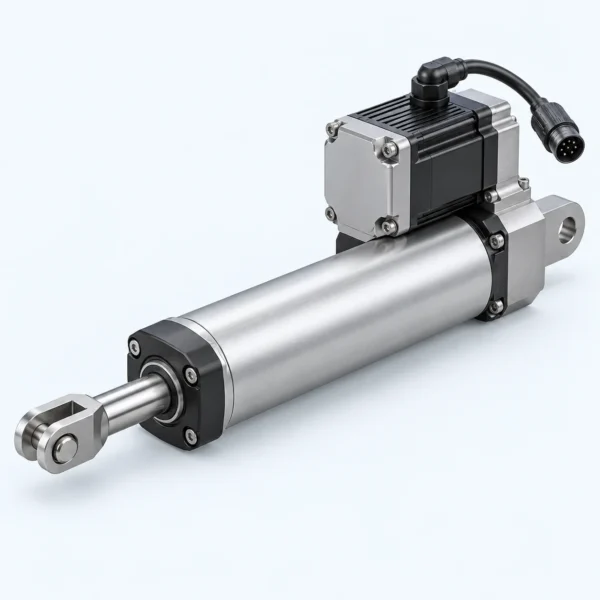
Current specifications are confirmed per requirement. RobotPiece does not infer ratings, fit, life, accuracy, compatibility, or included items from a generic name or product-type image. Final construction, dimensions, connectors, finish, and appearance depend on the approved configuration and supply boundary.
Inquiry Checklist
- Stroke
- Moving load
- Thrust profile
- Speed
- Acceleration
- Duty cycle
- Repeatability
- Side load
- Orientation
- Lubrication
- And motor-control boundary
- Prototype and expected production quantity, delivery destination, schedule, and required documents
Send drawings and requirements through the RobotPiece quote list or the contact page. Related products are organized in the Actuators category.
Frequently Asked Questions
Is every roller screw linear actuator a complete servo axis?
No. The quoted boundary may stop at the screw transmission, a guided mechanical cylinder, or a fuller axis. Motor, feedback, brake, drive, cables, sensors, and commissioning must be listed explicitly.
What load information is needed?
Provide the force-time and speed-time profiles, acceleration, dwell and reversal pattern, external side loads, orientation, expected cycles, abnormal events, and the acceptance criteria for motion and life.
Can RobotPiece confirm a roller screw actuator from an image?
No. An image can help identify the general product family, but selection and quotation require the interface, operating conditions, scope, quantity, destination, and supporting drawings or data. Unknown values should be marked as open rather than guessed.
Image note: the cover is a conceptual product-type illustration, not a photograph of a confirmed model. Actual appearance, dimensions, connectors and supplied items must be confirmed in the quotation.
