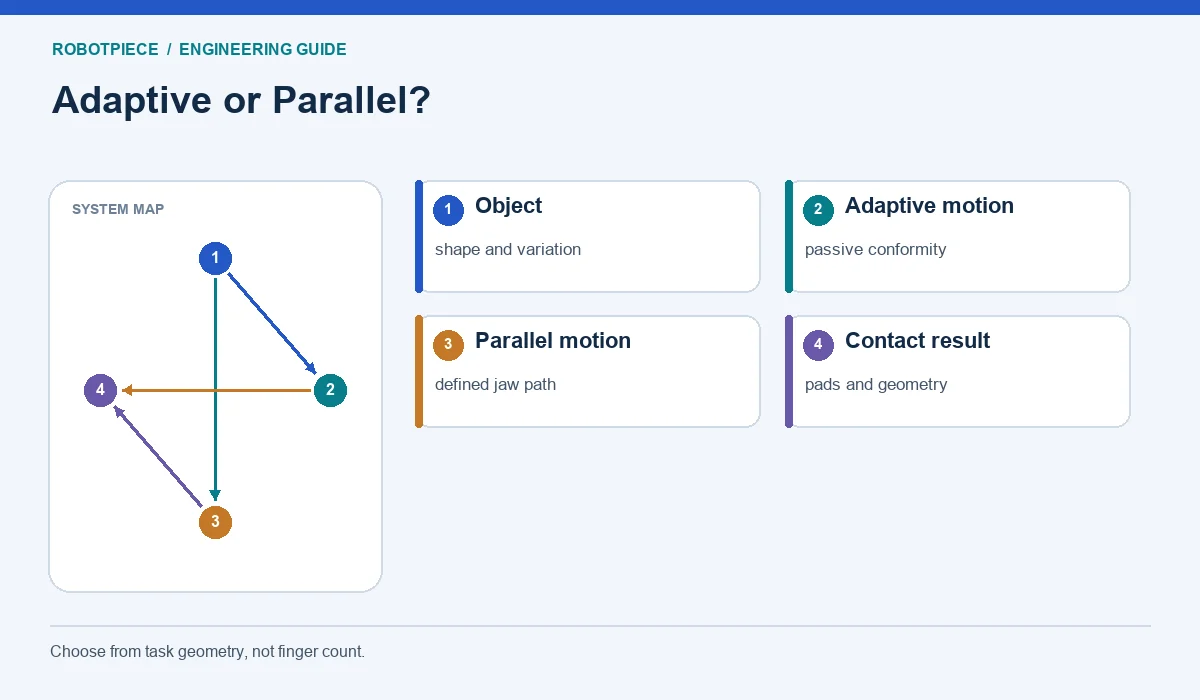
An adaptive gripper vs parallel gripper decision begins with the object and contact strategy, not with finger count. A two-finger tool may move its fingertips in parallel, adapt around a shape through under-actuated joints, or combine both behaviors over different portions of its stroke. Buyers should describe the grasp they need, then verify the actual motion, force, interface, and fingertip package.
Adaptive Gripper vs Parallel Gripper: Describe the Object and Contact Surfaces
List the minimum and maximum object dimensions, mass, center of gravity, surface finish, stiffness, temperature, and permitted contact zones. Include geometric variation and presentation error. A rigid machined part approaching the gripper in a repeatable fixture presents a different problem from a bag, casting, or mixed bin. State whether the grasp is internal or external and whether the object must be centered, enveloped, or held only at two defined pads.
Contact material changes the system. Soft pads can increase conformity but may compress, wear, or mark a surface. Hard fingers can locate precisely but require suitable geometry and alignment. Record cleanliness, food-contact, static-control, and replacement requirements before selecting adaptive gripper fingers.
Electric Parallel Gripper Motion Patterns Beyond Finger Count

An electric parallel gripper normally drives opposing jaws along a defined parallel path. That motion is convenient for repeatable dimensional gripping and for custom fingertips designed around a known part. An adaptive robot gripper uses mechanical compliance or under-actuation to let contact alter the final finger posture. Robotiq’s 2-Finger Adaptive Gripper manual, for example, describes articulated, under-actuated fingers that may create an encompassing or fingertip grasp depending on where contact occurs.
This is why “2 finger robot gripper” is not a sufficient architecture description. Confirm jaw or fingertip trajectory throughout the complete stroke. Ask what happens when one finger contacts first, how object detection is determined, and whether the commanded position represents motor travel, jaw separation, or another internal scale. For precision loading, also ask how repeatability is specified and measured.
Adaptive Robot Gripper Motion Comparison
- Parallel path: useful when consistent opposing contact and predictable geometry are central.
- Adaptive path: useful when passive conformity helps accommodate shape or placement variation.
- Hybrid behavior: possible when articulated fingers act approximately parallel in one region and envelop an object in another.
Check Gripper Stroke and Object Size Alongside Force
Compare usable opening with the selected fingertips installed, not the base unit’s headline stroke. State gripping force at the relevant finger length and contact location because longer fingers increase moments at the jaw guides. Provide the robot wrist pattern, allowable tool mass, payload moment, supply voltage or pneumatic requirements, control interface, cable exit, and safety strategy.
SCHUNK’s parallel-gripper catalog demonstrates why drive type, stroke per jaw, force range, sensing, and application environment are separate filters. Use the exact model drawing and manual for final selection. Do not transfer a force, ingress rating, or duty statement from one series to another.
Choose Adaptive Gripper Fingers and Plan a Sample Task
Define whether the quote includes the gripper body, robot adapter, fingertips, pads, fasteners, cable, controller, software package, and spare wear items. A complete gripper is not the same purchase as replacement fingers. For custom fingers, provide mounting-hole geometry, datums, material, permissible mass, contact profile, and inspection criteria.
A sample task should reproduce object variation, approach direction, acceleration, and expected disturbances. Agree on pass criteria such as successful pickup, retained orientation, no prohibited marks, and reliable release. The test should use the proposed fingers and settings rather than a demonstration accessory.
Browse the dexterous hands and grippers category, then send object drawings, contact materials, and the intended grasping task for a configuration review.
Score the candidates against one task
Use the same object set and acceptance test for every candidate. A practical matrix can score usable opening with the proposed fingers, contact repeatability, tolerance to pose error, permissible finger length, changeover time, control interface, part-detection method, and recovery after a missed grasp. Mark requirements as mandatory, preferred, or informative before seeing product literature. This prevents an attractive force or stroke figure from dominating the decision. Include the robot’s payload and wrist moment with the adapter, gripper, fingers, and cable, then verify collision space through the full motion. Re-run the adaptive gripper vs parallel gripper comparison when the proposed fingertips or target objects change; an adaptive robot gripper and a 2 finger robot gripper can meet different acceptance limits. Finally, identify what must be proven by drawing, what can be demonstrated in a sample task, and what remains a system-integration responsibility. That distinction makes the final recommendation reviewable.
References: Robotiq 2-Finger Adaptive Gripper manual; SCHUNK parallel gripper catalog.