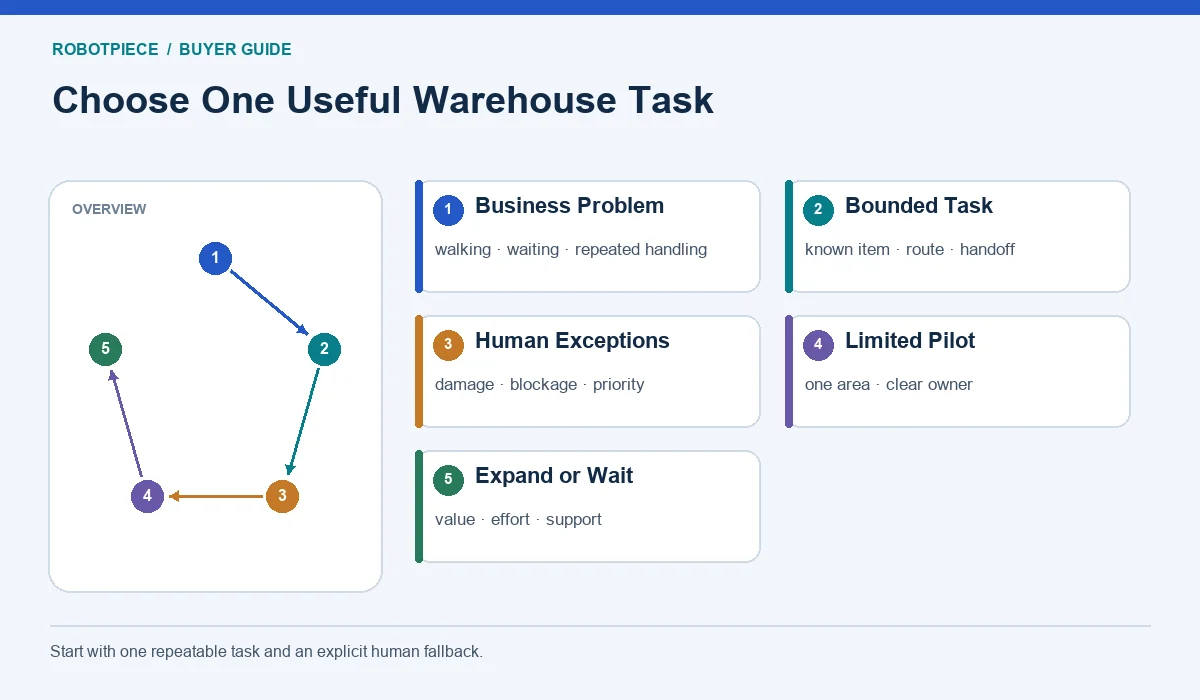
Humanoid robot warehouse task selection starts with a job that fits the site and operating model. Their human-like shape may help them work around shelves, carts, totes, handles, and workstations designed for people. That does not mean every warehouse activity should become a humanoid project. The best first use is usually a narrow, repetitive job with a clear route, manageable objects, and an easy way for people to step in.
For buyers, humanoid robot warehouse task selection is less about whether a robot can perform an impressive demonstration and more about whether it can deliver a dependable shift within the site’s real operating rules. A sensible evaluation looks at the task, the environment, the handoff to existing systems, and the cost of exceptions before discussing a full deployment.
How to Choose Warehouse Humanoid Pilot Tasks
Warehouse humanoid pilot tasks can start with moving totes or small containers between fixed stations when routes are repeatable and pickup points are clearly presented. The robot does not need to solve the whole warehouse. It needs to collect from one defined area, travel through an approved route, and place the item at another defined station.
Other warehouse humanoid pilot tasks include feeding a workstation. A robot could bring packaging materials, empty bins, or commonly used supplies to a person or machine. This can reduce walking while keeping the skilled worker focused on inspection, packing, or assembly. The value comes from a smoother flow, not from removing every human touch.
Simple shelf-to-cart or cart-to-shelf transfers can make sense when the items are consistent in shape, weight, presentation, and storage position. A suitable adaptive robot gripper may help with a defined family of objects, but buyers should still confirm the real item range, packaging condition, and permitted handling method.
Routine inspection rounds are another possible starting point. A robot may follow a fixed route and capture visual evidence, check that marked locations are clear, or report an exception to a person. This is different from asking the robot to make final safety or quality decisions on its own.
| Possible first task | What makes it suitable | What the buyer should confirm |
|---|---|---|
| Tote transfer | Fixed pickup, route, and drop-off | Container range, handoff method, blocked-route response |
| Workstation supply | Repeatable requests and known delivery point | Replenishment rules, priority, human interaction |
| Simple picking | Consistent objects and presentation | Grip method, damaged packaging, exception flow |
| Inspection round | Defined route and checklist | Evidence required and who decides the outcome |
Humanoid Material Handling Limits for a First Pilot
Humanoid material handling limits are easiest to see in high-speed picking across thousands of changing items, which is usually a poor first pilot. So are jobs involving torn bags, tangled materials, leaking containers, sharp edges, unstable stacks, or frequent recovery from clutter. These conditions may eventually be addressed, but they make it hard to learn whether the basic deployment creates value.
Heavy or awkward lifting is another area where humanoid material handling limits require caution. A robot that can move an object in a staged demonstration may not be suitable for repeated handling across a full shift. Buyers need a clear approved load, object position, travel path, and safe response when the item shifts. Do not treat a promotional clip as proof of site readiness.
Mixed pedestrian and vehicle traffic can turn a simple task into an operational challenge. If forklifts, pallet trucks, temporary pallets, and people constantly change the route, the first pilot may need a quieter area or a dedicated time window. The site should decide who has priority, how the robot yields, and what happens when the route stays blocked.

Warehouse Route Readiness for Robots
Warehouse route readiness for robots begins with one shift problem that has an owner. It might be excessive walking between two stations, irregular replenishment that stops a packing cell, or a repetitive transfer that is difficult to staff consistently. Write the current process in plain language and identify what a successful robot-assisted version would improve.
Once warehouse route readiness for robots is understood, useful pilot outcomes may include more predictable material arrival, less non-value-added walking, fewer missed replenishment calls, or better evidence from inspection rounds. Keep the measures tied to the chosen task. Avoid broad promises about replacing labor or transforming the entire warehouse.
A hypothetical example: a warehouse could test delivery of one tote type from a staging rack to two packing stations during a limited shift window. A person handles damaged totes, blocked aisles, and urgent reprioritization. This is an illustrative pilot, not a claim about an existing customer or guaranteed performance.
Build a Humanoid Deployment Recovery Plan
A humanoid deployment recovery plan must cover more than the robot. A warehouse pilot needs suitable end effectors, joint modules, cables, power, charging, communications, and service access. The published humanoid robot parts list can help buyers discuss these delivery boundaries without assuming one universal design. An integrated robot joint actuator, for example, may simplify sourcing for part of the motion system, but it does not by itself define the complete warehouse solution.
The humanoid deployment recovery plan should also cover the surrounding process. Does the robot receive work from a warehouse system or from a person? Where does it wait? Who clears a failed pickup? Who approves a new item? Where are spare parts kept? How quickly can the task return to manual operation? These questions often decide whether a pilot remains useful after the first demonstration.
Questions to Ask a Humanoid Robot Supplier
- Which exact warehouse task is included in the proposal?
- What item types, pickup conditions, routes, and drop-off points were assumed?
- Which exceptions require a person, and how is that person notified?
- What site changes, fixtures, carts, markers, network access, or charging area are required?
- What is included in integration, operator training, maintenance, and spare-parts support?
- How will the pilot be judged, and what happens if it does not meet the agreed outcome?
- Which claims come from the proposed configuration rather than a different demonstration platform?
A Practical Go/Wait Decision
Proceed when the task is narrow, frequent, valuable, and easy to describe; the objects and handoffs are controlled; exceptions have a human owner; and the site can run a limited pilot safely. Wait when the business problem is vague, success depends on many unproven tasks at once, or the proposal requires buyers to assume that a general-purpose robot will handle every variation.
The scope of humanoid robot warehouse task selection may eventually expand because warehouses are largely built around human reach and movement. The strongest first purchase decision is still specific: choose one useful job, make the operating boundaries visible, and learn from a controlled deployment before expanding the scope.
References
- Alishba Imran and Keerthana Gopalakrishnan, AI for Robotics, Industrial Robotics and Humanoid Robotics, PDF pp. 389–435 (printed pp. 375–422), Apress, 2025.
- Wei Zhang, Guoyu Zuo, and Xingxing Wang, Humanoid Robots: Fundamentals and Applications, applications and future outlook, PDF pp. 40–43 (printed pp. 29–32), Springer Singapore / China Machine Press, 2026.