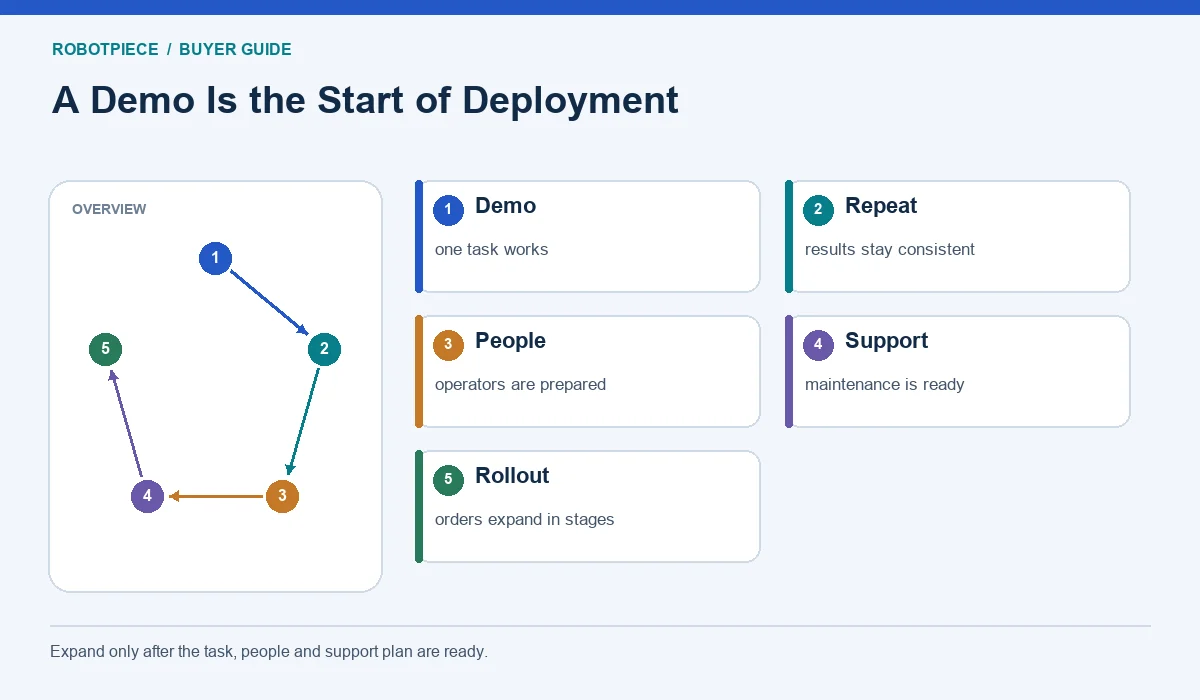
Robot prototype to production readiness takes more than repeating a successful demonstration. A demo answers an important first question: can the idea work? A production project must answer several more: will it work with normal part variation, can operators recover from common stops, can maintenance restore it quickly, and can suppliers deliver the same documented configuration again?
The next step in robot prototype to production readiness is a controlled handover, not an immediate full-volume purchase. Use the demo to define the real job, test repeatability, prepare the people who will run it, and close documentation and support gaps before expanding the order.
Robotics Production Design Review
A robotics production design review should write down exactly what the demonstration proved. Name the parts used, how they arrived, what condition they were in, who loaded them, what result counted as success, and which exceptions were excluded. A robot that handled ten clean samples on a bench has not automatically proven that it can handle mixed finishes, damaged packaging, shifted fixtures or upstream delays.
Keep the robotics production design review understandable to production, quality, maintenance and purchasing. For example, “pick this family of parts from these trays and place them in this fixture” is clearer than “automate material handling.” Add the conditions that send a part to manual review. Clear boundaries prevent the supplier and buyer from assuming different jobs.
Prototype Validation Before Manufacturing
Prototype validation before manufacturing requires repeated runs with representative good parts and known difficult parts. Include normal changes between operators, shifts, batches and starting positions. Record stops and recoveries instead of quietly resetting the cell and continuing the video.
The goal of prototype validation before manufacturing is not to demand that nothing ever goes wrong. It is to learn which events are normal, how often they appear, whether the system recognizes them, and what action restores production. A useful trial produces a short list of accepted conditions, rejected conditions and open questions.

Prepare Operators Before the First Production Shift
Robot operator training should use the actual production routine. Operators need to know how to start and stop the equipment, load material correctly, recognize a normal warning, clear an approved minor stop, and escalate anything outside their authority. Give them a simple visual guide at the station and a contact path that works during the intended shifts.
Separate operator actions from maintenance actions. If a recovery requires opening guarded equipment, changing a component or altering a setting, it should move to the trained maintenance team. The handover should make this boundary obvious rather than leaving it to judgment during a stoppage.
Robot Service Readiness Planning
Robot service readiness planning should list items that wear, items that may be damaged during a jam, and items with long replacement lead times. Decide which should be held on site, which can be shared across several cells, and which require supplier support. A robot spare parts hardware kit can organize common service items, but the buyer must still confirm the exact robot revision, quantities and included parts.
Also define how a replacement will be installed and checked. A spare without the correct cable, connector, mounting hardware or setup record may not restore production. For joint and control work, an actuator commissioning kit may support bench preparation when its interfaces and included tools match the project.
Request a Production Handover Package
A production handover should identify the configuration that was tested and the documents needed to repeat it. Depending on the project, request:
- approved drawings and interface descriptions;
- a parts list with revision and included-scope notes;
- wiring and connector records;
- startup, shutdown and approved recovery instructions;
- maintenance intervals and replaceable-item list;
- software or configuration backup ownership;
- inspection or calibration records where the task needs them; and
- supplier contacts and escalation responsibilities.
Harnesses deserve special attention because a prototype cable can become a production weakness if routing, strain relief and connector protection are not controlled. A robot wiring harness quotation should identify both end interfaces, motion requirements, length, protection, labels and supplied documentation.
Robot BOM Revision Control for Staged Orders
Robot BOM revision control supports orders placed in stages that match the evidence. A first stage may cover engineering samples and one pilot cell. The next may cover a small production group plus agreed spares. A broader rollout should follow only after the pilot has produced repeatable results and the support process has worked during real operation.
Suppliers also use robot BOM revision control to gain time to confirm repeatability. Ask how the production item will be matched to the approved sample, how substitutions are reviewed, how revisions are communicated, and what records travel with each lot. A lower unit price has little value if each batch requires new integration work.
Agree Who Owns Each Open Item
Keep one open-item list with an owner and due date for every question. Typical owners include the robot integrator, component supplier, buyer, plant maintenance, quality team and safety reviewer. Examples include fixture changes, sample approval, training completion, spare quantities and document updates.
Do not let open items disappear into meeting notes. Before the pilot moves to routine production, decide which items must be closed and which can remain as controlled limitations.
A Practical Readiness Review
Before expanding the order, bring production, maintenance, quality, purchasing and the supplier together. Review five questions:
- Is the task scope clear, including parts the robot should reject?
- Have repeated runs covered realistic variation and common stops?
- Can trained staff operate and recover the system on the intended shifts?
- Are maintenance tools, spares and current documents available?
- Does the next order stage match the evidence already collected?
A successful demo creates usable evidence that advances robot prototype to production readiness. The path from robot prototype to production is the work of turning that evidence into a repeatable task, a trained team, a supportable configuration and a purchasing plan that grows only as confidence grows.
References
- Robert H. Bishop (ed.), Mechatronic Systems, Sensors, and Actuators, Chapters 2 and 3.
- Amit Kumar Tyagi (ed.), AI-Powered Robotic Perception Systems, Chapter 3.
- Official Scrivener Publishing book page.