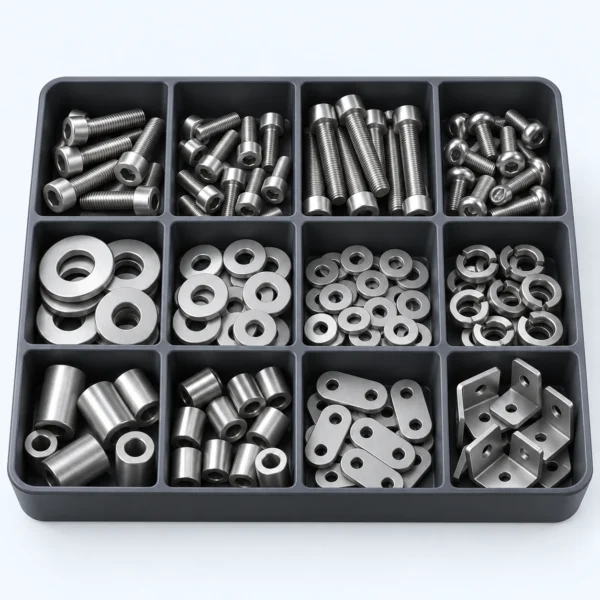
The Robot Spare Parts Kit groups approved replaceable hardware and service items for a documented robot configuration and maintenance task. This page is an unbranded request-for-quotation entry for an application-specific product type, not a fixed stocked model. Share the assembly, interface, environment, quantity, and documentation requirements so the proposed supply boundary can be reviewed before quotation.
Robot Spare Parts Kit Selection and RFQ Requirements
Revision control is central: a mechanically similar spare can still have the wrong material, finish, wiring, or interface. The review begins with the function of the item in the robot, then separates mechanical fit, electrical or material requirements, operating conditions, service access, and verification. Similar-looking parts are not treated as interchangeable. Drawings, connector schedules, photographs of mating interfaces, and revision-controlled bills of materials are more useful than a product-family name alone.

How to specify the Robot Spare Parts Kit
Provide the intended function and identify the two interfaces or assembly boundaries that the item connects. The initial review should address the following points:
- Target Assembly Revision And Service Operation: provide the drawing, schedule, or requirement that controls this decision.
- Bill Of Materials With Quantity Per Item: provide the drawing, schedule, or requirement that controls this decision.
- Replacement Criteria And Required Tools: provide the drawing, schedule, or requirement that controls this decision.
- Packaging, Labels, Preservation, And Traceability: provide the drawing, schedule, or requirement that controls this decision.
Identify the exact robot subsystem, assembly revision, service operation, and maintenance document. Supply an approved bill of materials that lists each part, quantity, drawing or part identity, and replacement criterion. Describe packaging, labels, preservation, shelf-life controls if applicable, and whether tools or consumables are separate. A kit for field service may need task-based grouping, while a production spares pack may need individual traceability and replenishment rules.
Configuration, Interfaces, and Quoted Scope
A robot spare parts kit is quoted only from an approved, revision-controlled list. No fastener, replacement component, consumable, tool, or document is included merely because it appears in a generic service illustration. The quotation should identify the exact deliverable, quantity, revision, and supplied state. It should also list excluded mating parts, customer-provided items, required tools, documentation, and acceptance evidence. Options may be compared, but they remain alternatives until a specific configuration is approved.
A robot hardware kit usually contains defined fasteners or mounting items, while a robot maintenance kit may be organized around a scheduled service task. A robot service kit and a robot repair parts kit can have different replacement criteria, consumables, tooling, and documentation. None of these names substitutes for a controlled itemized bill of materials tied to the target revision.
Robot Spare Parts Kit verification before quotation
- Confirm product identity from controlled drawings, interface definitions, or an approved sample.
- Review mechanical, electrical, material, environmental, and motion requirements as separate evidence sets.
- Record every included component and accessory, including both mating halves where applicable.
- Agree the inspection, continuity, dimensional, visual, functional, or documentation checks relevant to the item.
- Freeze the approved revision before production quantities or interchangeability are discussed.
An Engineering reference is provided as background for preparing the inquiry. It does not define the specification of a proposed item or certify that a generic product meets the application.
Inquiry Checklist
- Robot subsystem, installation location, function, and development phase
- Interface drawings, connector or part identities, revision, and mating direction
- Operating duty, routing or load conditions, environment, and maintenance expectations
- Required included items, tools, files, labels, packaging, and inspection documents
- Prototype quantity, production estimate, destination, and target schedule
Submit the available information through the RobotPiece quote list or contact page. Related product-type inquiries are organized under the Hardware category.
A robot hardware kit should be tied to a drawing or assembly step, while a robot maintenance kit should match a documented preventive-service task. A robot service kit may add consumables or approved tools, and a robot repair parts kit may contain replacement components for one diagnosed failure. These boundaries should remain separate in the bill of materials and packaging plan.
Frequently Asked Questions
Can one spare-parts kit cover several robot revisions?
Only if the approved compatibility matrix identifies the common and revision-specific items. Otherwise each revision should have its own controlled kit definition.
How are kit contents verified?
Define item identity, quantity, labels, packaging, visual or dimensional checks, and any functional evidence needed before dispatch. A photograph alone is not an acceptance record.
Does the illustration define the delivered robot spare parts kit?
No. The cover is a conceptual product-type illustration, not a photograph of a confirmed model. Actual dimensions, materials, connectors, finish, markings, included items, and supplied documents must be stated in the approved quotation.
