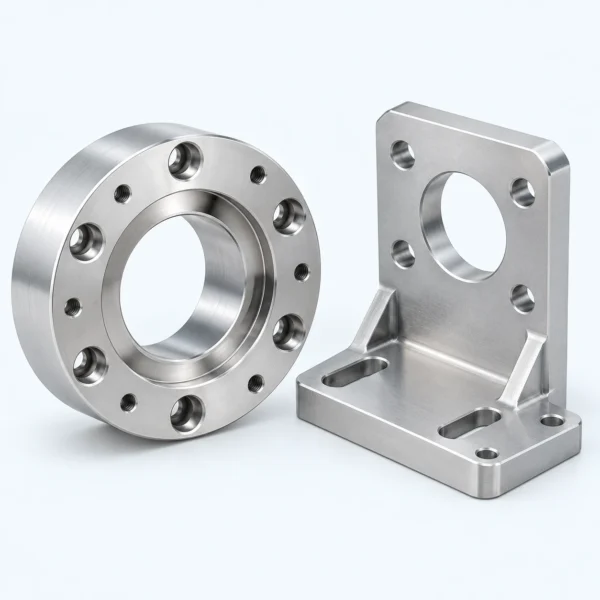
The Robot Wrist Adapter Flange connects a robot joint, wrist, sensor, tool, or structural member across two controlled mechanical interfaces. This page is an unbranded request-for-quotation entry for an application-specific product type, not a fixed stocked model. Share the assembly, interface, environment, quantity, and documentation requirements so the proposed supply boundary can be reviewed before quotation.
Robot Wrist Adapter Flange Selection and RFQ Requirements
Matching hole circles is insufficient; locating, runout, stack height, tool clearance, and load path must also be checked. The review begins with the function of the item in the robot, then separates mechanical fit, electrical or material requirements, operating conditions, service access, and verification. Similar-looking parts are not treated as interchangeable. Drawings, connector schedules, photographs of mating interfaces, and revision-controlled bills of materials are more useful than a product-family name alone.

How to specify the Robot Wrist Adapter Flange
Provide the intended function and identify the two interfaces or assembly boundaries that the item connects. The initial review should address the following points:
- Both Mating Patterns And Locating Datums: provide the drawing, schedule, or requirement that controls this decision.
- Load Cases And Allowable Deflection: provide the drawing, schedule, or requirement that controls this decision.
- Material, Heat Treatment, Finish, And Mass Target: provide the drawing, schedule, or requirement that controls this decision.
- Fasteners, Precision Shims, Access, And Assembly Sequence: provide the drawing, schedule, or requirement that controls this decision.
Provide drawings for both mating sides, including locating diameters, pilot features, bolt patterns, datums, stack height, cable passages, tool access, and adjacent interference zones. Describe all load cases and the allowable deflection or alignment result established by the joint designer. Material, heat treatment, finish, mass target, fastener class, dowels, and inspection datums require explicit definition. If the part also protects a cable or encoder, include those clearance and service requirements in the same assembly view.
Configuration, Interfaces, and Quoted Scope
A robot wrist adapter flange or robot mounting bracket is produced from an approved drawing. Fasteners, dowels, covers, shims, and inspection reports are separate scope items unless listed. The quotation should identify the exact deliverable, quantity, revision, and supplied state. It should also list excluded mating parts, customer-provided items, required tools, documentation, and acceptance evidence. Options may be compared, but they remain alternatives until a specific configuration is approved.
A robot joint flange typically transfers load at a rotary joint interface, while a robot mounting bracket may support a housing, sensor, or auxiliary device. A robot hardware kit can accompany either one but is a separate bill of materials. Precision shims may adjust the installed stack only when the approved design includes them.
Robot Wrist Adapter Flange verification before quotation
- Confirm product identity from controlled drawings, interface definitions, or an approved sample.
- Review mechanical, electrical, material, environmental, and motion requirements as separate evidence sets.
- Record every included component and accessory, including both mating halves where applicable.
- Agree the inspection, continuity, dimensional, visual, functional, or documentation checks relevant to the item.
- Freeze the approved revision before production quantities or interchangeability are discussed.
An Engineering reference is provided as background for preparing the inquiry. It does not define the specification of a proposed item or certify that a generic product meets the application.
Inquiry Checklist
- Robot subsystem, installation location, function, and development phase
- Interface drawings, connector or part identities, revision, and mating direction
- Operating duty, routing or load conditions, environment, and maintenance expectations
- Required included items, tools, files, labels, packaging, and inspection documents
- Prototype quantity, production estimate, destination, and target schedule
Submit the available information through the RobotPiece quote list or contact page. Related product-type inquiries are organized under the Hardware category.
The released robot joint flange drawing should control its locating diameter, bolt pattern, stack height, runout datums, and cable passage. If installation also uses a robot hardware kit, list every fastener and dowel rather than treating it as part of the flange name. Any precision shims used to set alignment or clearance need their own thickness, outline, material, and stack-position definition.
Frequently Asked Questions
Can an adapter be made from two bolt-circle dimensions?
No. Locating features, datums, stack height, load path, material, fasteners, runout, cable clearance, finish, and inspection also need definition.
Are fasteners, dowels, and shims included with the flange?
Only when the approved bill of materials and quotation list them. Each item needs its own material, quantity, finish, and installation role.
Does the illustration define the delivered robot wrist adapter flange?
No. The cover is a conceptual product-type illustration, not a photograph of a confirmed model. Actual dimensions, materials, connectors, finish, markings, included items, and supplied documents must be stated in the approved quotation.
