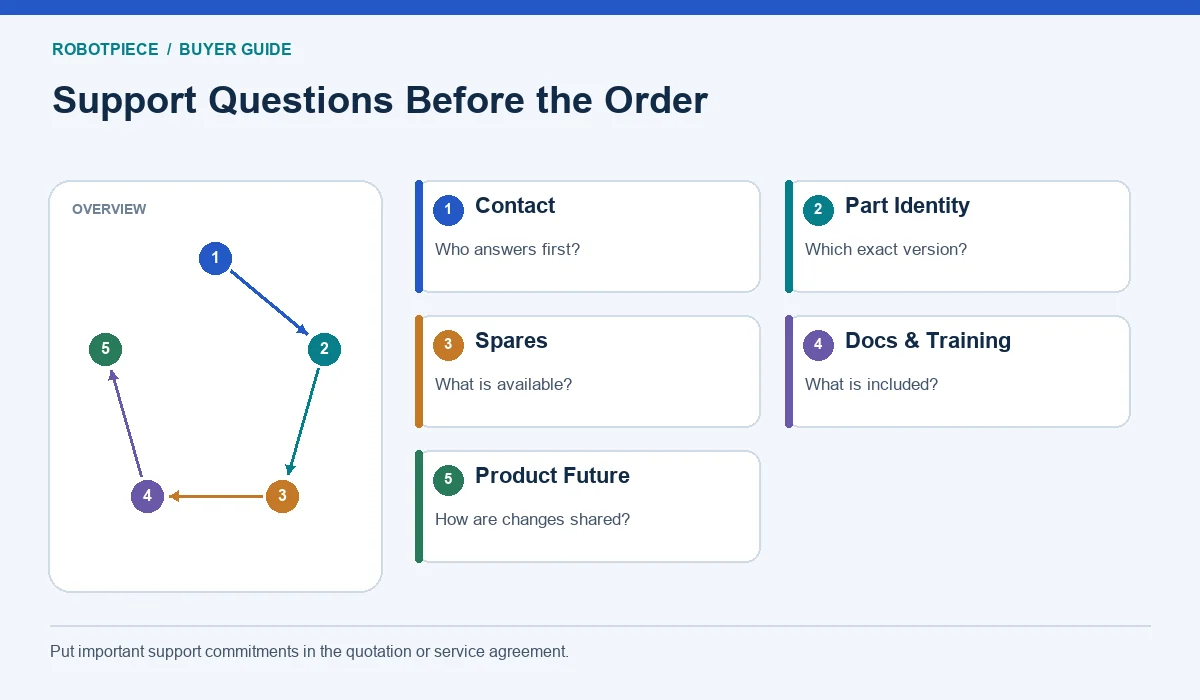
A robot after sales support checklist can matter as much as the component itself. A buyer may receive the correct motor, joint, encoder, sensor, cable, or gripper and still face delays later because nobody agreed who would answer questions, identify a replacement, review a returned part, or provide updated documents.
Complete the checklist before an order. The goal is not to demand unlimited support. It is to understand the support path, what is included, what requires a separate service, and what information both sides must keep.
Robotics Support Response Process
A robotics support response process needs more than “Contact us if you have a problem.” Ask for the normal contact method, working hours, expected language, and the information needed to open a case. Find out whether the first contact is the seller, manufacturer, system integrator, or a local service partner.
The robotics support response process should tell the support team what it will need: the exact item, order reference, serial or batch information where available, photos, and a plain description of what happened. Ask who keeps this information and how a request is handed to another company when several suppliers are involved.
The book A Startup Field Guide in the Age of Robots and AI repeatedly links robot adoption with dependable customer support. Its examples show that buyers may prefer their own maintenance staff or trusted partners, while other customers expect the supplier to provide field service. Neither model is automatically better. The important point is to know the model before equipment is needed.
Confirm How Parts Will Be Identified
A replacement request can fail because the buyer and supplier are using different names for the same item. Keep the quoted product name, configuration, drawing or revision, order date, and any supplier reference together. If a robot contains several similar joints or cables, record where each one is used.
An integrated robot joint actuator may combine several functions in one delivered unit. Ask whether support applies to the complete unit or to selected internal parts. A robot wiring harness may be specific to a robot revision, connector choice, or length. “The same harness” is not enough if those details changed.

Confirm Robot Spare Parts Availability
Robot spare parts availability depends on which items are normally kept in stock, which are made to order, and which have long lead times. A seller may recommend holding selected spares, but the right list depends on the customer’s own equipment, usage, number of machines, delivery time, and ability to wait.
Identification is another part of robot spare parts availability. Ask whether the supplier can confirm a replacement from the original order, photo, serial information, or drawing. If the original item is unavailable, find out who reviews a substitute and what information will be provided before the buyer approves it.
Do not treat robot spare parts availability as complete if “compatible” is assumed to mean identical. A replacement may affect mounting, connectors, software, accessories, or included documents. The buyer’s responsible team should approve a change before it is treated as a normal spare.
Decide Who Repairs and Who Replaces
Some components are normally replaced as a complete unit. Others may be returned for inspection or repair. Ask what options exist, where the item would be sent, who pays shipping, what information must accompany it, and whether the supplier provides an estimate before paid work begins.
Clarify the limits of local work. Can the customer’s team replace the item? Is a trained partner required? Would opening the unit change the available warranty or service option?
If downtime is important, ask whether an advance replacement, loan unit, or exchange service exists. Do not assume it does. Record any promised service separately in the quotation or service agreement.
Define the Robot Maintenance Training Scope
The robot maintenance training scope should reference useful documents including the product identification, installation or user guide, approved drawing, included accessories, care instructions, and contact route for questions. Ask which version will be delivered and how updates are communicated.
Robot maintenance training should match the customer’s role. Operators may need to know when to stop and whom to call. Maintenance staff may need approved replacement procedures and parts identification. Purchasing staff may need the correct order description. A training session with no retained materials or named audience is difficult to use months later.
Complete the robot maintenance training scope by asking whether training is included, remote, on site, recorded, or separately quoted. Also ask whether new staff can access the same materials later.
Separate Warranty, Paid Support, and Goodwill
Buyers should ask what the warranty covers, how long it applies, what evidence is required, and which situations are excluded. They should also ask what happens after that period.
Separate three things:
- Warranty support: the written remedy and conditions that accompany the sale.
- Paid support: optional services, visits, repairs, training, or priority response purchased separately.
- Goodwill help: informal assistance that may be useful but is not a guaranteed service level.
Commercial terms vary by supplier and country. The buyer should review the actual quotation and agreement rather than relying on a general blog checklist.
Component End of Life Support
Component end of life support matters because robot projects often operate longer than one purchasing cycle. Ask how the supplier announces product changes, whether older documents remain available, and what happens if a component is discontinued. A component end-of-life plan may include a last-order notice, a suggested replacement, continued repair for a period, or no special option at all.
Upgrade reviews are another part of component end of life support, so name their owner. A newer model may offer benefits but still require changes elsewhere in the robot. Purchasing should not assume that a new part number can replace an old one without the responsible technical team’s approval.
An Illustrative Support Conversation
Imagine a buyer ordering several robot components for a prototype. This is an illustrative example, not a real RobotPiece customer case. Before ordering, the buyer and seller list the exact items, the normal support email, the information required for a case, and the person responsible for approving a substitute.
They also agree which spare has the longest lead time, whether a complete unit would be replaced or returned, which documents will accompany the order, and how discontinuation notices will be shared. Months later, the buyer does not have to begin with “Which version did we buy?” The earlier record gives both sides a practical starting point.
Robot Support Questions Before Purchase
- Who receives the first request, and during what hours?
- What order, product, photo, serial, or revision information is required?
- Which spares are stocked, made to order, or likely to take longer?
- Who approves a substitute or upgraded item?
- Is the normal remedy repair, return, exchange, or full replacement?
- What documents and training are included?
- What is covered by warranty, and what support is separately paid?
- How are product changes and discontinuation communicated?
Clear ownership and accurate records make a robot after sales support checklist work best. Ask these questions while the order is still being discussed, put important commitments in writing, and keep the support information with the product record.
Sources and Further Reading
- Oliver Mitchell, A Startup Field Guide in the Age of Robots and AI (Chapman & Hall/CRC Press, 2025), Chapter 1, PDF pp. 21–22; Chapter 3, PDF pp. 39–40; Chapter 5, PDF pp. 54–55; and Chapter 8, PDF pp. 100–102.