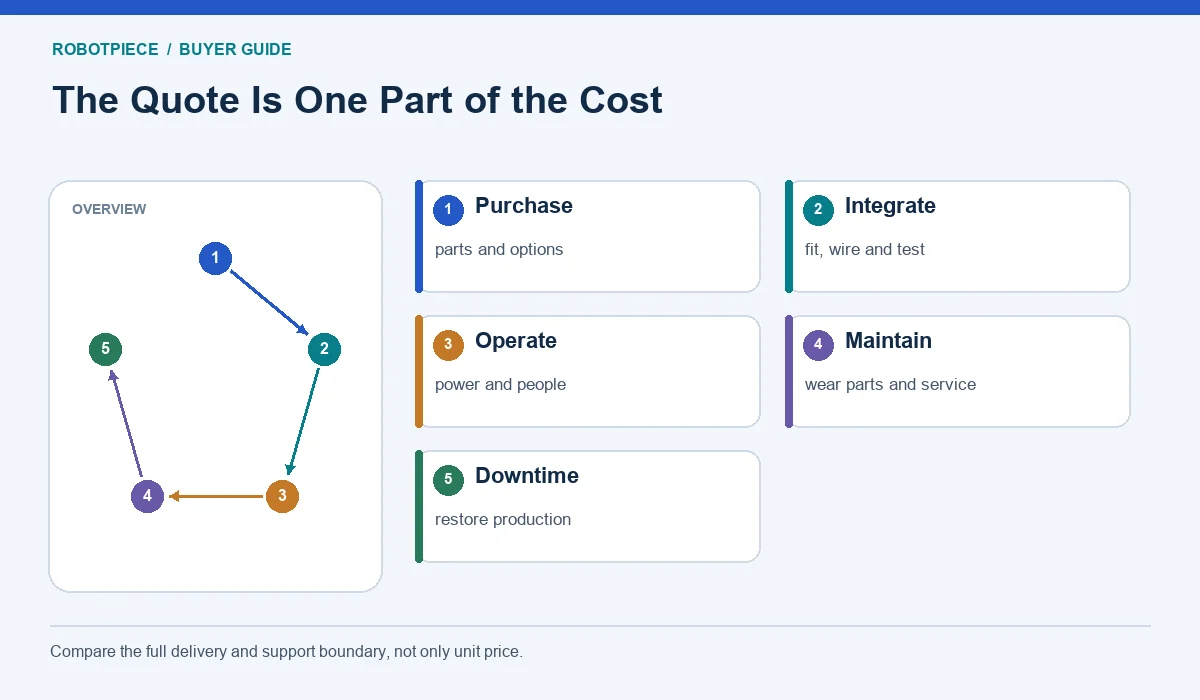
A robot total operating cost checklist begins before the purchase order and continues through service. A component can look inexpensive and still create a costly project if it needs unusual integration work, causes long stoppages, uses hard-to-source wear parts or arrives without the documents needed for maintenance. Buyers get a better comparison by asking how each option will be installed, operated, supported and replaced.
The checklist does not require a complicated financial model. A consistent quotation checklist can reveal the main long-term cost differences before the order is placed.
Robot Lifecycle Cost Planning
Robot lifecycle cost planning starts by comparing what is included, optional and customer-supplied. A robot component may require a cable, mating connector, mounting adapter, drive, setup tool or software before it can be used. If one supplier includes these items and another does not, unit prices are not directly comparable.
Ask each supplier to mark the same scope sheet. Include hardware, accessories, drawings, inspection records, packaging, training and support. Confirm whether the quoted item is ready for the intended robot or only one element inside a larger assembly.
Count Integration Work as a Real Cost
Integration includes mechanical fit, wiring, mounting, protection, setup, testing and production handover. It also includes the time needed to resolve unclear interfaces. A well-documented component with familiar connections may reduce project effort even when its purchase price is higher.
Look closely at wiring. Custom cables, uncertain pinouts and poor strain relief can add design time and later become service problems. A robot wiring harness request should state both end interfaces, movement, length, protection and labeling so buyers can compare like with like.

Automation Downtime Cost Drivers
The effect of automation downtime cost drivers depends on the process, so avoid unsupported savings claims. Instead, compare recovery conditions. Can the maintenance team identify the failed item? Is a replacement available? Are instructions and setup records current? Does the supplier provide a clear escalation contact?
Other automation downtime cost drivers include long or uncertain component lead times, which may require more on-site spares. A more integrated component may be faster to exchange but more expensive to hold. Neither choice is always better. The right answer depends on the production line, acceptable stoppage and local maintenance ability.
Build a Robot Spare Parts Budget
A robot spare parts budget begins by asking which items are expected to wear, which can be replaced separately and which require replacement of a larger module. Common examples may include finger pads, seals, bearings, cables, connectors, fasteners or protective covers, depending on the equipment.
Organize the robot spare parts budget by recovery purpose:
- Immediate recovery: parts needed to restart a critical cell.
- Planned maintenance: items replaced during scheduled service.
- Damage recovery: parts that may be lost during a collision or jam.
- Long-lead protection: items held because replenishment is slow.
A robot spare parts hardware kit can group service items, but the quotation should identify the robot revision, quantities and exclusions. “Spare kit included” is not enough detail for a maintenance plan.
Review Energy and Utility Needs in Plain Terms
Ask for the operating conditions behind any energy information. Compare normal production, waiting, holding and shutdown states. Include required cooling, compressed air or other utilities where relevant. The goal is not to predict a guaranteed bill from one catalog number. It is to avoid discovering after installation that an option needs additional plant services or cannot enter a low-use state during long waits.
When suppliers present efficiency or consumption claims, ask what equipment boundary was measured and under what task. A motor-only figure does not describe a complete joint, and a complete joint does not describe the full robot cell.
Value Documentation and Change Control
Good documents reduce dependence on the person who built the prototype. Request current drawings, connectors, included parts, service instructions and a revision identifier. Ask how substitutions are approved and how buyers are informed when a component, cable or internal design changes.
For an integrated robot joint actuator, the useful record is not only the module name. Buyers may need the exact configuration, mounting interface, cable set, supplied accessories and setup boundary. The documentation package should follow the item through prototype, production and service.
Complete a Robotics Support Cost Review
A robotics support cost review should define what “technical support available” means. Ask which channel is used, the normal service hours, what information the supplier needs, whether remote review is possible, and which problems belong to the integrator rather than the component supplier. Do not assume a response time unless it is stated in the quotation or agreement.
The robotics support cost review should also ask what happens if the original item becomes unavailable. Can the supplier propose an alternative with a clear comparison? Will drawings or samples be reviewed before substitution? Is the buyer responsible for all revalidation?
Use One Comparison Sheet for Every Quote
| Cost area | Question for the quote |
|---|---|
| Integration | What else is needed to install and test this item? |
| Downtime | How is a failed item identified, replaced and restored? |
| Spares | Which items wear, and what are their lead times? |
| Utilities | What power, cooling or air is needed in normal use? |
| Documents | Which drawings, records and revisions are supplied? |
| Support | Who responds, through which channel, and for what scope? |
A robot total operating cost checklist makes operating costs easier to manage when the buyer turns hidden assumptions into quotation fields. Compare the whole delivery and support boundary, then choose the option that the plant can install, run, maintain and recover with acceptable uncertainty.
References
- Robert H. Bishop (ed.), Mechatronic Systems, Sensors, and Actuators, Chapter 2.
- Amit Kumar Tyagi (ed.), AI-Powered Robotic Perception Systems, Chapters 3 and 14.
- Official Scrivener Publishing book page.