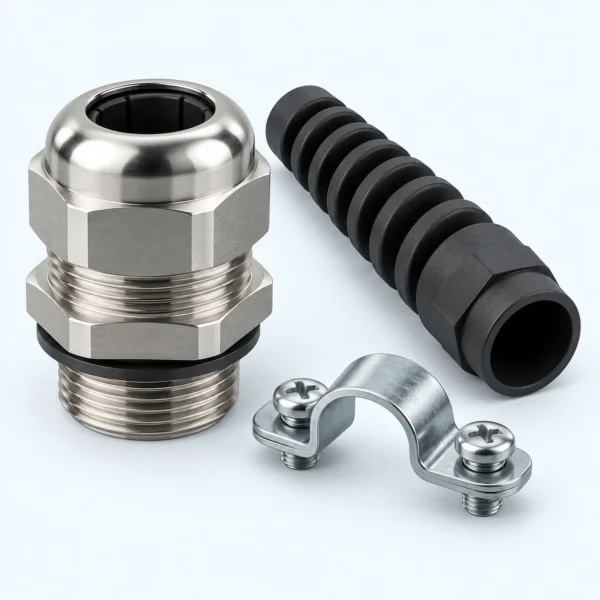
The Cable Strain Relief controls cable loading where a cable enters a connector, enclosure, bracket, or moving assembly. This page is an unbranded request-for-quotation entry for an application-specific product type, not a fixed stocked model. Share the assembly, interface, environment, quantity, and documentation requirements so the proposed supply boundary can be reviewed before quotation.
Cable Strain Relief Selection and RFQ Requirements
Retention, sealing, flex life, and bend control are different requirements; one accessory is not assumed to satisfy all four. The review begins with the function of the item in the robot, then separates mechanical fit, electrical or material requirements, operating conditions, service access, and verification. Similar-looking parts are not treated as interchangeable. Drawings, connector schedules, photographs of mating interfaces, and revision-controlled bills of materials are more useful than a product-family name alone.

How to specify the Cable Strain Relief
Provide the intended function and identify the two interfaces or assembly boundaries that the item connects. The initial review should address the following points:
- Cable Outside Diameter And Construction: provide the drawing, schedule, or requirement that controls this decision.
- Entry Thread Or Panel Opening: provide the drawing, schedule, or requirement that controls this decision.
- Required Retention And Bend Management: provide the drawing, schedule, or requirement that controls this decision.
- Sealing, Temperature, Fluids, And Cleaning Exposure: provide the drawing, schedule, or requirement that controls this decision.
Provide the cable outside diameter range, jacket material, internal bundle construction, and the panel or connector entry drawing. State whether the purpose is bend control, pull retention, sealing, abrasion protection, or a combination, then describe vibration, flexing, fluids, dust, cleaning, and temperature exposure. For a threaded entry, identify the thread and available wall thickness; for a molded transition, provide the overmold boundary and cable preparation. Installation torque and inspection needs remain configuration-specific and should not be guessed.
Configuration, Interfaces, and Quoted Scope
The quotation separates a strain relief cord grip, a strain relief cable gland, and a molded cable strain relief because their assembly methods and supply boundaries differ. The quotation should identify the exact deliverable, quantity, revision, and supplied state. It should also list excluded mating parts, customer-provided items, required tools, documentation, and acceptance evidence. Options may be compared, but they remain alternatives until a specific configuration is approved.
A wire strain relief may support individual conductors or a small bundle, while a strain relief cord grip usually clamps a jacketed cable at an entry. A strain relief cable gland can add environmental sealing when the complete entry is designed for it. A molded cable strain relief is produced as part of the cable assembly and has a different tooling and repair boundary.
Cable Strain Relief verification before quotation
- Confirm product identity from controlled drawings, interface definitions, or an approved sample.
- Review mechanical, electrical, material, environmental, and motion requirements as separate evidence sets.
- Record every included component and accessory, including both mating halves where applicable.
- Agree the inspection, continuity, dimensional, visual, functional, or documentation checks relevant to the item.
- Freeze the approved revision before production quantities or interchangeability are discussed.
An Engineering reference is provided as background for preparing the inquiry. It does not define the specification of a proposed item or certify that a generic product meets the application.
Inquiry Checklist
- Robot subsystem, installation location, function, and development phase
- Interface drawings, connector or part identities, revision, and mating direction
- Operating duty, routing or load conditions, environment, and maintenance expectations
- Required included items, tools, files, labels, packaging, and inspection documents
- Prototype quantity, production estimate, destination, and target schedule
Submit the available information through the RobotPiece quote list or contact page. Related product-type inquiries are organized under the Hardware category.
Where individual conductors emerge from a protected bundle, specify whether wire strain relief is needed at the termination, at the enclosure entry, or at both locations. The requested retention method should be tied to the actual jacket, conductor preparation, pull direction, bend envelope, and service procedure rather than copied from an unrelated cable assembly.
Frequently Asked Questions
Is cable diameter enough to select a gland?
No. Entry thread, panel thickness, jacket material, retention, sealing target, bend requirements, temperature, fluids, and installation access also need review.
Can a strain-relief part be reused after cable replacement?
Reuse depends on the exact construction, condition, sealing elements, and approved maintenance procedure. Treat replacement hardware and inspection requirements as quotation items rather than assumptions.
Does the illustration define the delivered cable strain relief and gland?
No. The cover is a conceptual product-type illustration, not a photograph of a confirmed model. Actual dimensions, materials, connectors, finish, markings, included items, and supplied documents must be stated in the approved quotation.
