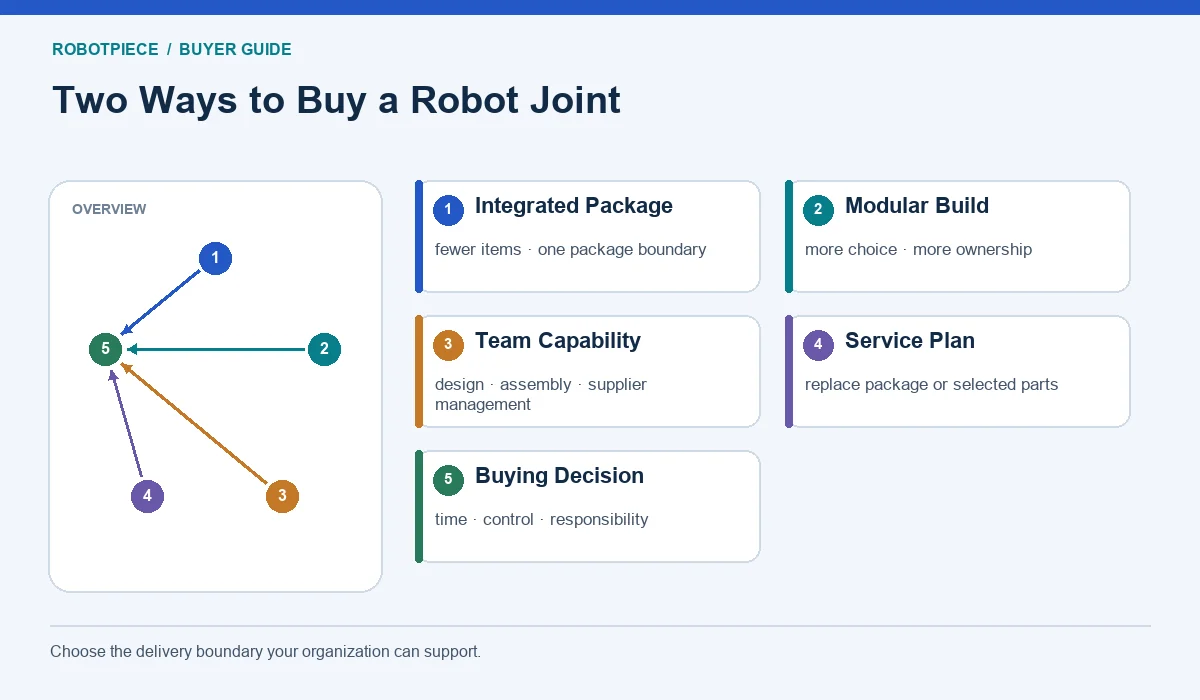
An integrated vs modular robot joints comparison covers purchasing, design, and integration responsibility. An integrated joint is purchased as a packaged assembly with several functions already combined. A modular approach buys the motor, reducer, feedback, bearings, housing, drive, cables, and related parts separately or in smaller groups.
Both routes can work. Start the comparison with the project organization. The better choice depends on how quickly the buyer needs a prototype, how much design control the team wants, who will own integration problems, and how the robot will be maintained over its life. A useful comparison then tests the component specifications against those organizational needs.
When a Packaged Robot Joint Fits
A packaged robot joint, such as an integrated robot joint actuator, may suit a team that wants to reduce the number of separate purchasing and assembly decisions. The supplier may provide a motor, transmission, feedback, support structure, housing, and sometimes drive or brake as one defined package. The actual included scope must be confirmed for the proposed model.
This packaged robot joint approach can help an early prototype team move faster because fewer interfaces are designed from the beginning. It may also give the buyer one contact for the packaged joint’s assembly quality and basic documentation. When several robot axes use the same joint family, ordering, installation, and replacement can become easier to organize.
The tradeoff is less freedom inside the packaged robot joint. The team works with the supplier’s envelope, connection points, service method, and available options. If the application later needs a different layout or one internal component changes, the whole package may need to be reviewed.
When Modular Joint Integration Is Worth the Work
Modular joint integration may suit an experienced engineering team that needs control over packaging, supplier choice, serviceability, or the use of common components across several robot models. The buyer may pair a frameless torque motor kit with a selected reducer, bearings, encoder, drive, and custom housing.
In modular joint integration, individual parts can be easier to replace or dual-source. It can also support a robot shape that a standard packaged joint cannot fit. The value is flexibility and ownership. The cost is that the buyer must manage more drawings, suppliers, assembly steps, documentation, and troubleshooting boundaries.
For modular joint integration, compare component purchase prices with the costs of custom design, fixtures, assembly, rework, validation, and supplier coordination. Ask the integrated supplier to identify included parts and service support as well.
| Buyer question | Integrated joint | Modular joint |
|---|---|---|
| Speed to first prototype | Often fewer items to combine | More design and supplier coordination |
| Design freedom | Works within package options | Greater control over each part and layout |
| Problem ownership | Potentially one package owner | Buyer manages boundaries among suppliers |
| Maintenance | Replace or service the package | Replace selected parts if access allows |
| Future sourcing | Depends more on joint-family continuity | More alternatives, but more qualification work |
Actuator Interface Responsibility
Actuator interface responsibility becomes critical when several suppliers share one assembly, because many delays happen between them. If a motor and precision robot gearbox come from different sources, who confirms that the mounting and delivery scope match? Who supplies the coupling or housing? Who investigates noise after assembly? Who keeps the approved drawing set?
Ask the package supplier to state what it owns and what remains the robot builder’s responsibility. For a modular joint, create a written actuator interface responsibility table covering design, purchasing, assembly, wiring, setup, documentation, spare parts, and issue resolution. This is a business tool: it prevents two suppliers from assuming the other party owns the missing interface.

Robot Joint Serviceability Before Design Freeze
Robot joint serviceability depends on access and replacement options. An integrated package can simplify field replacement when the joint is accessible and stocked. A technician may exchange one assembly rather than diagnose internal parts at the machine. Buyers should still ask whether the supplier repairs the unit, replaces it, or expects the customer to service internal components.
A modular design can improve robot joint serviceability by allowing replacement of one damaged part, but only if the robot was designed for access and the organization can repeat the assembly correctly. A theoretically replaceable bearing or encoder has limited value if changing it requires extensive disassembly, special tooling, or a setup process the field team cannot perform.
The supplier’s robot joint serviceability plan should state component availability, revision notice, and how replacements are matched to an older robot. Avoid promises about service life unless they are supported by the actual supplier and operating conditions.
Information to Prepare Before Requesting Quotes
Buyers do not need to finish every detail before contacting suppliers, but they should provide enough context for comparable proposals:
- Robot type, target joint location, and intended task.
- Available space, mounting concept, and drawing revision.
- Expected movement, load direction, duty, environment, and safety approach in plain language.
- Power and communication preferences already fixed by the project.
- Prototype quantity, expected later quantity, and desired schedule.
- Items that must be included, may be optional, or will be supplied by the buyer.
- Required documents, cables, software, setup support, warranty, and spare-parts expectations.
A hypothetical startup building its first lower-body prototype might choose packaged joints to reduce the number of early integration tasks. A mature robot company with a fixed housing platform and established assembly team might prefer modular parts to control cost and service over several product versions. These are illustrative situations, not claims about a particular customer.
Questions for Supplier Comparison
- Exactly which parts and accessories are included in the quoted joint?
- Which items shown in marketing images are optional?
- How is actuator interface responsibility assigned, including drawing and change approval?
- What setup, cables, software, and documentation come with prototypes?
- What is the replacement and repair process?
- Can the supplier support the expected prototype and production quantities?
- How are future revisions communicated and qualified?
- Which exclusions could create additional design or purchasing work for the buyer?
Choose the Route Your Organization Can Support
The integrated vs modular robot joints decision should match the organization. Select an integrated joint when reducing development steps and clarifying package ownership matter more than controlling every internal part. Select modular integration when the organization has the time, people, drawings, supplier management, and service plan to own the complete assembly.
The decision can also vary by joint. A robot may use packaged modules in one area and a custom modular assembly where space or service needs are different. The important point is to make the delivery boundary and responsibility boundary visible before purchase orders are placed.
References
- Wei Zhang, Guoyu Zuo, and Xingxing Wang, Humanoid Robots: Fundamentals and Applications, mechanism design, actuation, transmission, assembly, and integration, PDF pp. 298–334 (printed pp. 291–327), Springer Singapore / China Machine Press, 2026.
- Alishba Imran and Keerthana Gopalakrishnan, AI for Robotics, humanoid hardware choices, PDF pp. 423–427 (printed pp. 410–414), Apress, 2025.